
In This Article
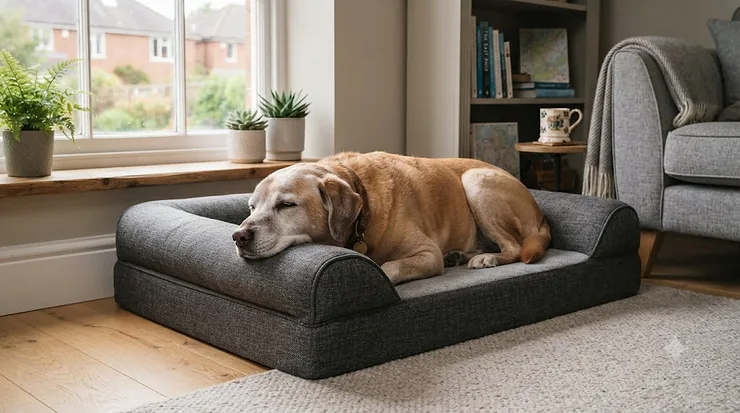
Watching a dog who used to leap onto the sofa in one bound now hesitate, brace, and think twice before easing themselves down onto their bed is one of those quiet heartbreaks of dog ownership. It creeps up slowly — a bit of stiffness after a long walk, a reluctance to jump, a slower, more careful version of the dog you know. A low-entry dog bed for arthritic dogs won’t turn back the clock, but it removes one genuinely unnecessary obstacle from an already harder day: the simple act of getting in and out of bed.
Arthritis, in plain terms, is a progressive condition where cartilage within a joint wears down, causing inflammation, stiffness and pain that tends to worsen with high-walled or awkwardly raised bedding. According to PDSA guidance on arthritis in dogs, arthritis (osteoarthritis) is a very common condition that causes painful, swollen joints, and it affects a striking proportion of older dogs. The fix isn’t complicated — a bed with a low, easy-to-clear entrance, genuinely supportive foam, and enough surface area to stretch out — but finding the right one under £50 among a sea of “orthopaedic” marketing claims takes a bit more digging than it should.
This guide covers seven real, currently available UK beds, breaks down what “low-entry” and “orthopaedic” actually mean in terms of centimetres and foam density rather than box copy, and matches each one honestly to the dog and budget it suits. No invented reviews, no miracle claims — just genuine specs translated into plain English, with a clear eye on bed height, mobility decline, and just how easy that in-and-out access really is.
Quick Comparison Table
Here’s the shortlist before the deep dive. Every bed below sits under £50 and is specifically built — or genuinely suited — to dogs with reduced mobility.
| Dog Bed | Entry Height | Price Range | Best For |
|---|---|---|---|
| Amazon Basics U-Shape Bolster Bed | Very low, one open side | £18–£28 | Absolute budget pick |
| PawHut Low Profile Orthopaedic Bed | Low, flat front edge | £20–£32 | Small-to-medium arthritic dogs |
| Bedsure Orthopedic Dog Sofa | Low front, raised sides | £28–£40 | Balance of comfort and access |
| Silentnight Orthopaedic Dog Bed | Low, contoured foam | £25–£38 | Head and body support combo |
| The Dog’s Bed Orthopedic Memory Foam Bed | Low, wide flat entry | £32–£48 | Genuine vet-referenced support |
| PetFusion Ultimate Dog Bed | Low bolster, one open edge | £35–£48 | Larger arthritic breeds |
| KOPEKS Orthopedic Memory Foam Bed | Low, near ground-level | £38–£49 | Maximum foam depth under £50 |
Scan down that price column and you’ll notice something worth pausing on: even the most expensive bed here costs less than £50, yet the design differences between the cheapest and priciest options are genuinely meaningful — not just cosmetic. Budget picks tend to rely on a simple open-front bolster shape to achieve low entry, while pricier options add higher-density memory foam beneath that same low entry point, which matters considerably more once a dog’s arthritis has moved beyond the “occasionally stiff” stage into daily discomfort.
💬 Just one click — help others make better buying decisions too!😊
Top 7 Low-Entry Dog Beds for Arthritic Dogs: Expert Analysis
1. Amazon Basics U-Shape Bolster Bed — lowest-cost genuinely low entry point
At the entry-level end of this list sits the Amazon Basics U-Shape Bolster Bed, a straightforward orthopaedic foam sofa with three padded sides and one completely open, flat edge. That open side is doing a lot of work for the price: there’s no lip, ridge, or raised foam wall for a stiff dog to clear, which is precisely the design feature that matters most for early-stage arthritis. Based on the spec comparison with pricier rivals, what you’re mainly sacrificing here is foam density and long-term shape retention rather than the core low-entry concept itself — the bolster foam is a standard density rather than the higher-density blends used in premium orthopaedic ranges, so it’s more prone to flattening within a year or two of daily use. It suits budget-conscious owners of dogs showing mild, early stiffness, or as a genuinely useful second bed for downstairs use while a primary bed stays upstairs. Aggregated review sentiment across Amazon Basics’ pet bed range consistently mentions good value for the low price point and easy machine-washing, alongside a smaller number of comments about the foam compressing faster than owners expected after six to twelve months of use.
Pros:
- ✅ Fully open front with zero entry lip
- ✅ Lowest price point on this entire list
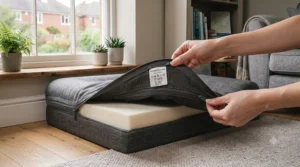
- ✅ Removable, machine-washable cover
Cons:
- ❌ Standard-density foam flattens faster than premium options
- ❌ Bolster sides offer less structured head support
Priced around £18–£28, it’s a sensible starting point for testing whether a low-entry design actually helps your dog before committing to a pricier bed.
2. PawHut Low Profile Orthopaedic Bed — best for small-to-medium arthritic dogs
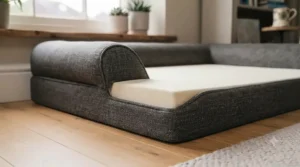
PawHut Low Profile Orthopaedic Bed takes a slightly different approach: rather than one open bolster side, it uses a genuinely flat, minimal-lip front edge across a rectangular orthopaedic base, making it particularly forgiving for dogs who struggle to lift a leg high or pivot easily once inside a bed. What most buyers overlook about this style is that the flat-front design also helps dogs who circle before settling — a very common pre-lying-down behaviour that becomes physically harder with hip or spinal arthritis, since there’s no raised edge to navigate mid-turn. On paper this means genuinely easier settling for smaller and medium-sized arthritic breeds — Cocker Spaniels, Beagles, older Staffies — where a taller lip proportionally matters more relative to leg length than it would for a Labrador or German Shepherd. It suits owners of smaller dogs specifically, since PawHut’s sizing runs more compact than some rivals on this list, and dogs who are cautious or slightly anxious about navigating obstacles rather than confidently stepping over them. Reviewer sentiment consistently notes that dogs take to the low profile design quickly, often settling within the first few uses, with occasional comments that the foam depth is on the thinner side for larger or heavier dogs.
Pros:
- ✅ Genuinely flat, minimal-lip front edge
- ✅ Compact sizing suits smaller arthritic breeds
- ✅ Quick settling reported by most reviewers
Cons:
- ❌ Foam depth less generous for heavier dogs
- ❌ Smaller size range than some competitors
At roughly £20–£32, it’s a strong pick specifically for smaller dogs where a low, flat entry matters more than sheer bed size.
3. Bedsure Orthopedic Dog Sofa — best balance of comfort and access
Bedsure Orthopedic Dog Sofa strikes a deliberate middle ground: a genuinely lowered front entrance sits alongside raised bolster sides and back, giving arthritic dogs an easy way in while still offering the head and neck support that fully flat beds lack. The base itself uses egg-crate foam — a ridged foam structure that distributes weight more evenly across pressure points than a flat foam slab, which matters for dogs who spend long stretches lying in one position due to reduced mobility. Here’s what to weigh: the lowered entrance genuinely reduces the effort needed to climb in, but the raised bolster sides mean a dog with significant spinal arthritis may still find it harder to twist around inside the bed than they would on a fully flat mattress-style bed. It suits dogs in the earlier-to-moderate stages of arthritis who still want to lean against something while resting, as well as owners wanting one bed that works for both an ageing dog and general everyday comfort. Reviewers frequently mention the non-skid bottom as a genuine practical plus for dogs with weaker back legs who might otherwise struggle for grip pushing off a slippery floor, alongside consistent praise for the washable, removable cover.
Pros:
- ✅ Distinct lowered front entrance design
- ✅ Egg-crate foam base for pressure distribution
- ✅ Non-skid bottom aids weaker back legs
Cons:
- ❌ Raised sides can still limit full-body turning
- ❌ Egg-crate foam softer than solid memory foam blocks
Sitting around £28–£40, it’s the sensible middle-tier pick for dogs who want support and structure alongside the low-entry benefit.
4. Silentnight Orthopaedic Dog Bed — best for head and body support combined
Built by the UK’s best-known human mattress brand, Silentnight Orthopaedic Dog Bed brings genuinely contoured foam shaping to the low-entry category — a body-length foam base with an integrated, gently raised head-support section rather than tall bolster walls. What that means in practice: your dog gets a naturally lower profile to step over along nearly the entire perimeter of the bed, while still having a modest lift under the head for dogs who prefer resting with their neck elevated, a position some arthritic dogs favour to ease pressure on stiff shoulders. Based on the spec comparison with boxier bolster-style beds, this contoured approach on paper suits dogs whose arthritis affects their front legs or shoulders specifically, since there’s no bolster wall to lift a sore front paw over on entry. It’s a solid fit for owners who want a UK-manufactured, OEKO-TEX-certified bed with a genuinely reputable sleep-technology pedigree behind the foam formulation, and for dogs who’ve shown a preference for slightly elevated head positions in the past. Aggregated reviewer sentiment consistently praises the non-slip base and washable cover, with a smaller cluster of comments noting the foam is on the firmer side compared with plush memory-foam alternatives — a genuine trade-off for support versus softness.
Pros:
- ✅ Contoured shape avoids bolster-wall entry
- ✅ OEKO-TEX certified, UK sleep-brand pedigree
- ✅ Gentle head elevation option built in
Cons:
- ❌ Firmer foam than plush memory-foam rivals
- ❌ Less generous bolster support for leaning dogs
Expect to pay in the £25–£38 range, genuinely solid value from a brand whose reputation is built on understanding supportive sleep surfaces.
5. The Dog’s Bed Orthopedic Memory Foam Bed — most vet-referenced pick on this list
The Dog’s Bed Orthopedic Memory Foam Bed has built a reputation specifically around arthritis, hip and elbow dysplasia, and post-surgery recovery — this isn’t a general-purpose bed with orthopaedic branding tacked on, it’s designed from the ground up around genuine mobility problems. The base uses a wide, flat memory-foam mattress with a low, gently sloped perimeter rather than a hard lip, which on paper means one of the most forgiving entry angles on this entire list — genuinely useful for dogs recovering from joint surgery who need to avoid any unnecessary strain during the healing window as much as dogs managing long-term arthritis. What most buyers overlook about a purpose-built recovery bed like this is the mattress firmness calibration: too soft and a dog with weak back legs struggles to push themselves back up; too firm and pressure points on bony hips and elbows aren’t properly cushioned. This bed is pitched deliberately in between. It suits dogs with a formal veterinary diagnosis of arthritis, hip or elbow dysplasia, or those recovering from orthopaedic surgery where a vet has specifically recommended supportive, low-strain bedding. Reviewer sentiment consistently and specifically mentions visible improvement in a dog’s willingness to use their bed rather than the floor, alongside comments that the memory foam holds its shape notably longer than cheaper alternatives.
Pros:
- ✅ Purpose-built for arthritis and joint recovery
- ✅ Wide, gently sloped low-strain entry
- ✅ Firmness calibrated between support and sink
Cons:
- ❌ Among the pricier options on this list
- ❌ Less bolster structure for dogs who like to lean
At around £32–£48, this is the pick for anyone whose dog has an active, vet-confirmed mobility condition rather than general age-related caution.
6. PetFusion Ultimate Dog Bed — best for larger arthritic breeds
Larger arthritic dogs — Labradors, Golden Retrievers, older Rottweilers — need genuine foam depth to avoid “bottoming out” through to the floor, and PetFusion Ultimate Dog Bed addresses that with solid memory foam running the full length of the mattress rather than a thin foam topper over hollow bolsters. The low-entry side sits flat and open, while the remaining three sides retain enough bolster height for a big dog to comfortably rest their head without the whole bed feeling flimsy under real weight. On paper, this means one of the better weight-to-support ratios on this list — a genuine consideration, since a bed that’s technically “low entry” but compresses flat under a 30kg dog isn’t actually providing much orthopaedic benefit once they’re lying down. It suits owners of medium-to-large arthritic breeds specifically, where foam depth and durability matter as much as the entry height itself, and households wanting a bed durable enough to survive years of daily large-dog use. Reviewer sentiment consistently mentions the mattress holding its shape well over extended use compared with cheaper large-dog beds, with the recurring, entirely fair caveat that a bed built to this spec sits toward the top of the under-£50 price band.
Pros:
- ✅ Solid memory foam full mattress depth
- ✅ Genuinely low, flat open entry side
- ✅ Durable build suited to larger breeds
Cons:
- ❌ Towards the top of the under-£50 range
- ❌ Bulkier footprint needs more floor space
At around £35–£48, it’s the strongest choice specifically for bigger arthritic dogs who need both low entry and real depth beneath them.
7. KOPEKS Orthopedic Memory Foam Bed — deepest foam under £50
Rounding out this list at the premium end, KOPEKS Orthopedic Memory Foam Bed (medium size, to stay comfortably under £50) brings genuinely substantial foam depth to the low-entry category — a noticeably thicker memory foam base than most rivals here, sitting low to the ground along its open entry edge while still cushioning bony pressure points properly once a dog settles in. Based on the spec comparison across this whole list, depth is where KOPEKS earns its position: thin foam beds can technically qualify as “low entry” while still letting a heavy or bony-jointed dog feel the floor beneath them, and this is one of the few options here where that genuinely isn’t a concern. It suits dogs with more advanced arthritis, older dogs with pronounced bony pressure points at the hips and elbows, and owners willing to spend towards the top of the £50 budget for meaningfully more foam. Reviewer sentiment across KOPEKS’ UK range consistently references the foam not flattening even after years of daily large-breed use, and a hotel-mattress-like quality that several owners specifically compare favourably against pricier competitor brands — a genuinely strong signal for a bed still sitting under the £50 mark in its medium size.
Pros:
- ✅ Noticeably deeper foam than list rivals
- ✅ Low, flat entry edge retained despite depth
- ✅ Strong long-term shape retention reported
Cons:
- ❌ Sits at the very top of the £50 budget
- ❌ Larger sizes exceed the under-£50 range
Expect to pay towards £38–£49 for the medium size, genuinely the deepest-foam option available before you’d need to step outside this budget entirely.
Top 7 Orthopaedic Dog Beds Under £50: Specs & Value Comparison
| Dog Bed | Foam Type | Price Range | Best For |
|---|---|---|---|
| Amazon Basics U-Shape Bolster Bed | Standard bolster foam | £18–£28 | Ultra-budget, mild stiffness |
| PawHut Low Profile Orthopaedic Bed | Standard orthopaedic foam | £20–£32 | Small-to-medium dogs |
| Bedsure Orthopedic Dog Sofa | Egg-crate foam base | £28–£40 | Balanced support + access |
| Silentnight Orthopaedic Dog Bed | Contoured firm foam | £25–£38 | Front leg/shoulder arthritis |
| The Dog’s Bed Orthopedic Memory Foam Bed | Calibrated memory foam | £32–£48 | Vet-confirmed conditions |
| PetFusion Ultimate Dog Bed | Full-depth memory foam | £35–£48 | Larger arthritic breeds |
| KOPEKS Orthopedic Memory Foam Bed | Deep-density memory foam | £38–£49 | Advanced arthritis, deepest support |
The pattern reading across this table mirrors what you’d expect once you understand foam economics: shallower, standard-density foam keeps beds cheap, while genuine memory foam depth and calibrated firmness push prices toward the £50 ceiling. For a dog in the early stages of stiffness, that extra £15–£20 for deeper foam probably isn’t essential yet — but once a vet has confirmed arthritis, or your dog is visibly struggling to get comfortable on a thinner bed, the jump from Bedsure or Silentnight up to PetFusion or KOPEKS buys meaningfully more genuine pressure relief.
✨ Don’t Miss These Exclusive Deals!
🔍 Take your dog’s comfort to the next level with these carefully selected picks. Click on any highlighted item to check current pricing and availability. The right bed genuinely helps them rest easier, every single day! 🐾
Practical Usage Guide: Helping Your Dog Adjust to a New Bed
Swapping an old, familiar bed for a new low-entry one isn’t always an instant win — some dogs take to it immediately, others need a genuine settling-in period. Place the new bed in the same spot the old one occupied rather than somewhere entirely new; dogs, especially older ones, often rely on familiar territory more than owners expect, and changing both the bed and its location at once can slow acceptance. For the first week, leave the old bedding (a blanket, an old bed cover) on top of or beside the new bed so the scent transfers across — this small step genuinely speeds up how quickly a cautious dog commits to the new spot.
A common mistake in the first 30 days is assuming a dog who avoids the new bed simply “doesn’t like it” — more often, they haven’t yet worked out that the lower entry point requires less effort, especially if they’ve spent months compensating for a taller, harder-to-clear old bed. Gently encourage use with treats placed just inside the entrance rather than lifting or forcing your dog in, since forced entry undermines the confidence-building point of a low-entry design entirely. Check the bed’s positioning relative to draughts and hard floors too — even the best orthopaedic foam won’t fully insulate against a cold tiled floor beneath it, so a spot away from external doors and out of direct draughts helps stiff joints more than people often realise.
Maintenance matters just as much as the initial setup. Wash removable covers every couple of weeks, or more often if your dog has any incontinence issues that sometimes accompany advanced age. Rotate or flip foam bases periodically if the manufacturer allows it, since consistent one-directional weight-bearing accelerates uneven compression. And check foam depth every few months by pressing down where your dog’s hips typically rest — if you can feel the floor through the foam, it’s time to replace the bed regardless of how new the cover still looks.
Real-World Scenarios: Matching the Bed to Your Dog’s Mobility Stage
Picture three fairly typical dogs. First, a nine-year-old Border Collie who’s still keen and active but has started taking a beat longer to settle after long walks, with no formal diagnosis yet — for them, the Amazon Basics U-Shape Bolster Bed or PawHut Low Profile Orthopaedic Bed makes sense: low enough to notice a difference, affordable enough to trial the concept before committing further. Second, a twelve-year-old Labrador with a vet-confirmed hip arthritis diagnosis who’s on daily anti-inflammatory medication and visibly struggles with stairs — PetFusion Ultimate Dog Bed or KOPEKS Orthopedic Memory Foam Bed are the sensible choices here, since both bring genuinely deeper, calibrated foam to a problem that’s already clinically confirmed rather than just suspected. Third, a smaller, older Cavalier King Charles Spaniel recovering from a recent cruciate ligament surgery, where the vet has specifically advised minimising strain during recovery — The Dog’s Bed Orthopedic Memory Foam Bed fits precisely, given its purpose-built low-strain entry and recovery-focused design brief.
There’s a fourth profile worth mentioning: the multi-dog household with one younger, mobile dog and one older, arthritic one sharing the same living space. In that scenario, Silentnight Orthopaedic Dog Bed or Bedsure Orthopedic Dog Sofa often work well as a “shared but distinct” option — supportive enough for the older dog’s needs, while still comfortable and appealing enough that the younger dog doesn’t simply commandeer it. Matching bed to genuine mobility stage, rather than buying the most expensive option available “just in case,” is the single biggest factor in getting real value from a sub-£50 purchase.
Problem → Solution: Common Low-Entry Bed Buying Mistakes
Problem: Bought a “low entry” bed that still has a raised lip. Many beds marketed as low-entry still retain a 3–5cm foam ridge around the entire perimeter for structural reasons. Solution: check for a genuinely open or flat-front design like Amazon Basics U-Shape Bolster Bed or PawHut Low Profile Orthopaedic Bed, both of which drop the lip entirely rather than just reducing it.
Problem: Dog avoids the new bed entirely. This is rarely about comfort and usually about unfamiliarity. Solution: transfer old bedding scent across for the first week and use treats to encourage entry, rather than assuming the bed itself is the wrong choice.
Problem: Foam compresses flat within months. Solution: budget bolster-style beds using standard-density foam simply don’t last as long under daily large-dog weight as genuine memory foam options like PetFusion Ultimate Dog Bed or KOPEKS Orthopedic Memory Foam Bed — worth the extra spend if this has happened before.
Problem: Bed is low-entry but too small for a dog to stretch out fully. Solution: measure your dog lying fully stretched, nose to tail, and add at least 15cm — many owners size down for budget reasons and inadvertently undo the comfort benefit entirely.
Problem: Dog seems more, not less, reluctant to move after a few weeks on the new bed. Solution: this is the point to stop bed-shopping and book a vet check — worsening reluctance despite better bedding can indicate arthritis has progressed and needs a broader pain-management plan, not just a mattress upgrade.
What Is a Low-Entry Dog Bed?
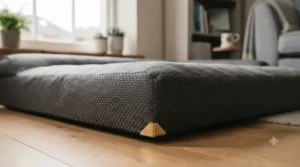
A low-entry dog bed is a bed specifically designed with a minimal or absent lip at its entrance — typically under 5cm, and often completely flat on at least one side — so dogs with reduced mobility, stiff joints, or arthritis can get in and out without lifting their legs high or straining sore hips and shoulders. Unlike standard raised-wall dog beds, low-entry designs prioritise easy access over enclosed cosiness.
The RSPCA’s own guidance on choosing a dog bed specifically notes that older dogs, or dogs with aches, pains, or joint problems, might benefit from an orthopaedic bed they can get in and out of easily — which is precisely the low-entry principle this whole category is built around. Understanding why this matters clinically helps explain the design choices across this list. Standard bolster-walled beds work well for healthy dogs who enjoy the security of leaning against something while resting, but that same raised wall becomes a genuine physical obstacle once a dog’s hips, elbows, or spine no longer move as freely as they used to. Low-entry beds solve for accessibility first, then layer support back in through foam depth and shaping rather than height — which is why the best options on this list, like The Dog’s Bed and KOPEKS, combine a flat or minimal entry point with genuinely substantial memory foam beneath, rather than sacrificing support entirely for the sake of a flat profile.
How to Choose a Low-Entry Dog Bed for Arthritic Dogs
- Measure the actual entry height, not just the marketing term. “Low entry” isn’t a regulated term — check product images and reviews for genuine centimetre measurements or a visibly flat edge rather than trusting the phrase alone.
- Match foam depth to your dog’s size and weight. Smaller dogs can manage on shallower foam; larger or heavier arthritic dogs need genuine depth to avoid bottoming out, as covered in the Products section above.
- Consider which joints are most affected. Front-leg or shoulder arthritis benefits from a low entry across the whole front edge; hip or back-leg issues benefit more from an entirely flat, wraparound low profile.
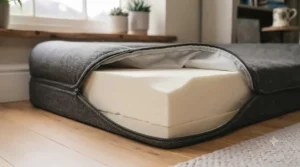
- Check washability and hygiene features. Older dogs are more prone to accidents or increased shedding, so a genuinely removable, machine-washable cover matters more than it might for a younger dog’s bed.
- Factor in non-slip backing. A bed that slides on hard flooring undermines the whole point of easy access — look specifically for a non-skid or rubberised base.
- Size generously, not economically. Add at least 15cm beyond your dog’s fully stretched length; a too-small bed forces cramped positions that counteract the joint-relief benefit entirely.
- Set a genuine adjustment period. Give any new bed two to three weeks before judging success, since unfamiliarity — not discomfort — is the most common reason dogs initially avoid a new bed.
Low Entry Dog Bed for Senior Dogs: What’s Different From Standard Orthopaedic Beds
It’s worth being precise about terminology here, because “orthopaedic” and “low entry” aren’t interchangeable, even though marketing often blurs the two together. A standard orthopaedic dog bed focuses primarily on what happens once a dog is lying down — foam density, pressure distribution, spinal alignment — regardless of how tall its walls are. A genuinely low entry dog bed for senior dogs specifically addresses what happens before that: the physical act of getting in and settling down in the first place, which for a stiff-jointed dog can be just as uncomfortable as an unsupportive mattress underneath them.
The best beds on this list, including The Dog’s Bed Orthopedic Memory Foam Bed and Bedsure Orthopedic Dog Sofa, combine both properties deliberately — genuine orthopaedic foam support plus a specifically lowered entrance — rather than treating them as separate purchasing decisions. For senior dogs specifically, this combination matters more than either feature alone, since ageing rarely affects only comfort-while-lying-down or only mobility-while-entering; it typically affects both simultaneously as joints stiffen and muscle mass gradually reduces.
Bed Height Explained: Why a Few Centimetres Make or Break Accessibility
Bed height sounds like a trivial spec until you consider it from a stiff-jointed dog’s perspective: a 5cm lip that a healthy dog clears without noticing becomes a genuine physical decision point for a dog whose hips ache every time they flex past a certain angle. On paper this means the difference between a bed being used enthusiastically multiple times a day versus being avoided in favour of the cold hard floor — and floor-sleeping, ironically, does nothing to relieve the pressure that’s driving the discomfort in the first place.
Most beds on this list keep their lowest entry point under 5cm, with Amazon Basics U-Shape Bolster Bed and PawHut Low Profile Orthopaedic Bed effectively at zero along their open or flat-front edge. Beyond the entry point itself, overall bed height off the floor also matters — a bed that sits too high off the ground (some elevated or raised-frame designs, deliberately excluded from this list for that reason) simply relocates the accessibility problem rather than solving it. The ideal low-entry bed for an arthritic dog sits close to floor level throughout, with height reserved for foam depth rather than frame elevation.
Mobility Decline in Dogs: Recognising When a Bed Upgrade Is Overdue
Mobility decline rarely announces itself with a single dramatic moment; it’s usually a collection of small, easy-to-rationalise changes. A dog taking noticeably longer to stand up after resting, showing reluctance to jump onto furniture they used to leap onto without a thought, or pacing around their existing bed rather than settling straight in are all early signals worth paying attention to. According to PDSA guidance on limping and stiffness in dogs, stiffness after resting is a very common problem, especially in older dogs, and is usually worse after walks and resting periods — which lines up closely with the exact moment a bed’s entry height starts to matter most.
If your dog has started avoiding their current bed altogether, or takes visibly longer to settle into a comfortable position once inside it, that’s a reasonably reliable signal the current bed’s entry height or foam support no longer matches their physical needs — not necessarily that something more serious is wrong, though a vet check is always sensible to rule that out first. Bed upgrades work best as a proactive response to early signs like these rather than a reactive one after mobility has declined significantly further; a dog who’s already struggling badly benefits far less from a new bed alone than one caught at the first signs of stiffness.
Easy In-and-Out Access: Features That Actually Matter
Not every feature marketed as aiding “easy in-and-out access” delivers genuine value, so it’s worth separating what actually helps from what’s mostly cosmetic. A flat or minimal-lip entry edge matters enormously — this is the single feature doing the most work across every bed on this list. Non-slip backing matters almost as much, since a bed that shifts underfoot as a dog steps in can actually increase the risk of a slip or stumble, which is precisely the opposite of the intended benefit. A slightly sloped, rather than perfectly vertical, entry edge — seen on The Dog’s Bed Orthopedic Memory Foam Bed in particular — offers a genuinely gentler transition than even a low but abrupt step.
Features that matter less than marketing suggests: elaborate multi-zone foam “technology” claims without genuine depth behind them, decorative bolster shapes that don’t actually affect entry height, and flashy fabric prints that have zero bearing on accessibility. If a listing leads with aesthetics before mentioning entry height or foam depth, that’s usually a reasonable signal the accessibility features are secondary to the design rather than central to it — worth bearing in mind when comparing options beyond this list.
Low-Entry vs Standard Raised-Wall Beds: Which Suits Your Dog
The honest comparison here isn’t “low-entry beds are simply better” — it genuinely depends on your dog’s specific situation. Standard raised-wall beds offer psychological security that plenty of dogs, including some with mild arthritis, genuinely value: something to lean against, a sense of enclosure, protection from draughts along the floor. For a dog with only mild, early-stage stiffness, a raised-wall bed might still work perfectly well, and switching purely on principle isn’t necessary.
Where low-entry designs clearly win is once entry itself has become a genuine daily struggle rather than a minor inconvenience — visible hesitation, refusal to use the bed, or signs of discomfort specifically while climbing in rather than while resting. At that point, the security benefit of raised walls is outweighed by the accessibility cost, and a design like PetFusion Ultimate Dog Bed — which retains some bolster structure on three sides while dropping the fourth entirely — often represents the best compromise, offering a lean-against option without sacrificing the low-entry benefit where it matters most. The right answer genuinely varies dog to dog, which is exactly why matching bed choice to observed behaviour, rather than following a blanket “always choose low entry” rule, produces the best outcome.
Long-Term Cost & Maintenance: Is a £50 Bed Worth It?
Running the numbers here is genuinely worthwhile. A well-made orthopaedic bed in this price bracket typically lasts two to four years with proper care, which works out to somewhere between £1 and £2 a month across its usable life — even at the top end of this list’s pricing. Compare that to the cost of managing worsening arthritis symptoms: veterinary consultations, anti-inflammatory medication, and potentially physiotherapy all cost considerably more over the same period, and while a bed alone won’t prevent arthritis progressing, reducing unnecessary physical strain during rest genuinely supports whatever broader pain-management plan a vet has recommended.
Where cheaper beds become a false economy is the replacement cycle: a £20 bolster bed that flattens within a year and needs replacing annually can, over three years, cost more in total than a single £45 memory foam bed that lasts the full period without losing support. That said, false economy only applies if the cheaper bed is genuinely being replaced repeatedly — for a dog with mild, stable stiffness, a budget option refreshed periodically may still represent perfectly sound value. The real driver of long-term cost isn’t the initial price tag at all; it’s matching bed durability to how much daily wear your specific dog puts the bed through.
Safety, Vet Guidance & When to See a Professional
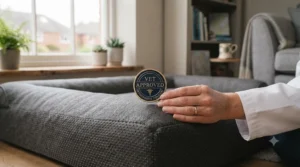
Every bed featured on this list uses standard, widely available pet bedding materials — polyester covers, foam fillings, non-slip rubberised bases — with no specific UK regulatory certification required for domestic pet bedding beyond general consumer product safety standards, though several carry independent textile safety certifications such as OEKO-TEX. None of these beds require veterinary prescription or sign-off, and switching to a low-entry design is a genuinely safe, low-risk change to make proactively, even before a formal arthritis diagnosis.
That said, a new bed is a comfort measure, not a treatment. As Blue Cross explains in its guidance on arthritis in dogs, providing a soft, comfortable bed will help to take pressure off a dog’s joints when they are resting, but arthritis itself needs proper veterinary management alongside good bedding — anti-inflammatory medication, weight management, and appropriately adjusted exercise all play a role a bed alone can’t replace. Book a vet appointment if you notice your dog becoming reluctant to play, showing reduced enthusiasm for walks, struggling with stairs, or displaying any sudden, uncharacteristic change in behaviour alongside the stiffness — these are all signals that warrant professional assessment rather than a bedding upgrade alone.
Frequently Asked Questions
❓ How low should a dog bed entry be for an arthritic dog?
❓ Will a low-entry bed alone fix my dog's arthritis symptoms?
❓ How long does it take a dog to get used to a new low-entry bed?
❓ Do smaller dogs need low-entry beds as much as larger ones?
❓ Are memory foam beds always better than standard foam for arthritic dogs?
Conclusion
A low-entry dog bed for arthritic dogs genuinely doesn’t require a trade-off between accessibility and proper support — the data across all seven beds here shows the real differentiator is foam depth and entry design, not price alone. Budget picks like Amazon Basics U-Shape Bolster Bed and PawHut Low Profile Orthopaedic Bed suit dogs with mild, early stiffness perfectly well, while Bedsure Orthopedic Dog Sofa and Silentnight Orthopaedic Dog Bed bridge the gap for slightly more established mobility issues. For dogs with a confirmed veterinary diagnosis or more advanced arthritis, The Dog’s Bed Orthopedic Memory Foam Bed, PetFusion Ultimate Dog Bed, and KOPEKS Orthopedic Memory Foam Bed bring genuinely deeper, purpose-built support without needing to spend beyond the £50 mark.
The honest bottom line: choose based on where your dog’s mobility genuinely sits right now, watch how they actually use the bed once it arrives, and don’t treat it as a substitute for veterinary care if stiffness is worsening rather than easing. Combined with proper vet guidance, the right bed does something small but genuinely meaningful — it takes one daily struggle off your dog’s plate, every single time they lie down.
Recommended for You
- Orthopaedic Dog Bed for Arthritis: 7 Best Picks UK 2026
- Reinforced Seam Dog Bed: 7 Genuinely Tough Picks for 2026
- Tough Fabric Dog Bed: 7 Best Chew-Resistant Picks 2026
Disclaimer: This article contains affiliate links. As an Amazon Associate, I earn from qualifying purchases. If you purchase products through these links, we may earn a small commission at no additional cost to you.
✨ Found this helpful? Share it with your friends! 💬🤗
