In This Article
Finding the right bed for your Siberian Husky in the UK presents unique challenges that many dog owners overlook. These arctic-bred beauties arrive in our homes with double coats designed for temperatures as low as -50°C, which means what works brilliantly for a Labrador can leave your Husky panting and uncomfortable on a mild British summer evening.
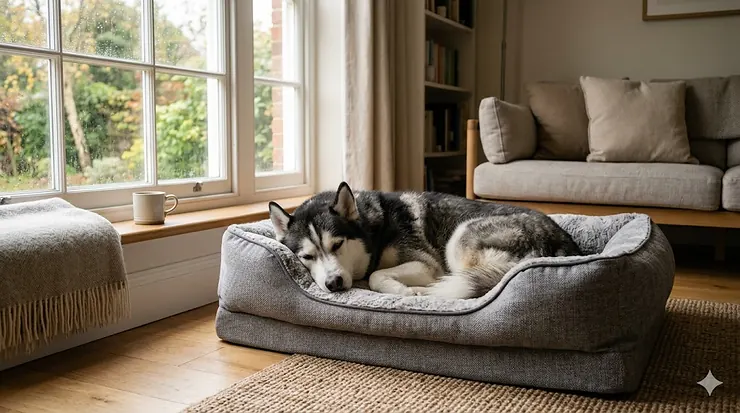
I’ve spent the better part of two decades working with arctic breeds across the UK, and the most common mistake I see is owners choosing beds based on size alone. Your Husky’s thick undercoat creates a microclimate around their body that traps heat remarkably well—brilliant for Siberian winters, rather less ideal for a semi-detached in Surrey during July. The best beds for Huskies prioritise cooling, durability against their instinctive digging behaviour, and proper joint support for these athletic dogs prone to hip dysplasia.
What most British Husky owners don’t realise is that even in normal household temperatures, Huskies can easily overheat, and beds that trap heat make them uncomfortable. This isn’t just about summer comfort—it’s about year-round wellbeing in centrally heated British homes where indoor temperatures often hover around 20°C, which is actually at the upper end of a Husky’s comfort zone. In this comprehensive guide, I’ll walk you through the seven best husky beds available on Amazon.co.uk in 2026, with honest assessments of what works in British homes, what doesn’t, and why your wallet will thank you for getting this decision right the first time.
Quick Comparison: Top Husky Beds at a Glance
| Bed Model | Best For | Price Range (£) | Cooling Features | Size Options |
|---|---|---|---|---|
| Bedsure Orthopedic Sofa | All-season comfort | £35-£55 | Egg-crate foam airflow | L, XL, XXL |
| K&H Cool Bed III | Maximum cooling | £40-£75 | Water-activated cooling | S, M, L |
| Veehoo Elevated Mesh | Budget cooling option | £25-£45 | Raised mesh design | M, L, XL |
| Berkeley Pocket Spring | Premium joint support | £180-£280 | Natural fibre breathability | L, XL |
| Furhaven Cooling Gel | Combination support | £45-£70 | Gel-infused memory foam | L, XL, Jumbo |
| Kuranda Chew-Proof Elevated | Destructive chewers | £120-£180 | Elevated airflow | M, L, XL |
| Silentnight Donut | Anxious Huskies | £30-£50 | Responsive fibres | M, L, XL |
From this comparison, the standout pattern is clear: elevated and breathable designs dominate the top tier for Huskies, whilst traditional cushioned beds only earn their place when they incorporate active cooling technology. Budget buyers should note that the Veehoo offers remarkable value under £50, but if your Husky’s a dedicated chewer, you’ll replace it twice before a Kuranda needs its first cover wash. The Berkeley sits in a league of its own for older Huskies with confirmed joint issues—the premium price reflects genuine orthopaedic engineering rather than marketing fluff.
💬 Just one click — help others make better buying decisions too! 😊
Top 7 Husky Beds: Expert Analysis for UK Owners
1. Bedsure Orthopedic Dog Bed Sofa — Best All-Rounder
The Bedsure Orthopedic Sofa has become something of a default choice amongst UK Husky owners, and for good reason. This bed features high-density egg-crate foam that provides genuine orthopaedic support whilst allowing considerably more airflow than solid memory foam—crucial for a breed that runs hot. The four-sided bolster design offers security without trapping heat, and the waterproof liner protects against those inevitable accidents during house-training or in senior years.
What sets this apart for British buyers is the removable, machine-washable flannel cover that survives repeated washing without pilling—important when you’re dealing with Husky fur tumbleweeds during their biannual coat blow. The bed measures 89x63x16cm in the large size, providing ample space for a full-grown Husky to stretch out properly. The non-slip base actually works on laminate and tile floors common in UK homes, unlike cheaper alternatives that slide across the kitchen at the first enthusiastic flop.
In my experience, this bed handles the British climate particularly well. The egg-crate design allows your Husky to nestle into the valleys during cooler months whilst the raised portions promote airflow when temperatures climb. UK buyers report the bed maintaining its shape remarkably well even after 12-18 months of daily use—a genuine achievement given how Huskies circle, dig, and rearrange before settling.
Pros:
✅ Egg-crate foam provides both support and cooling airflow
✅ Waterproof liner protects against accidents and spills
✅ Machine-washable cover survives repeated cleaning cycles
Cons:
❌ Not suitable for heavy chewers—zippers are vulnerable
❌ Takes 24-48 hours to fully expand after unboxing
Price & Verdict: Around £35-£55 depending on size. Exceptional value for Huskies without destructive chewing habits. The large size suits most UK Huskies perfectly, whilst the XXL accommodates larger males or those who like to sprawl. Prime delivery typically arrives next-day for most UK postcodes.
2. K&H Cool Bed III — Maximum Cooling Technology
The K&H Cool Bed III represents the gold standard for cooling beds amongst arctic breed specialists. This water-activated cooling mat uses a unique Cool Core technology that wicks heat out of your pet and releases it into the air, keeping pets cool without electricity or toxic gels. You fill it with 7-11 litres of water (depending on size), and the system maintains a surface temperature consistently below your Husky’s body temperature.
What UK owners particularly appreciate is that this bed works without refrigeration or electricity—rather useful given our energy costs. The cooling effect is genuine and measurable: even on a warm British summer day when your living room reaches 25°C, the bed surface stays noticeably cooler. The tough nylon/vinyl exterior withstands outdoor use beautifully, making it ideal for Huskies who spend time in the garden.
The learning curve here is real. You’ll need to experiment with water levels to find the optimal firmness for your Husky—more water provides stronger cooling and more cushioning but adds weight. Some UK buyers report initial wariness from their Huskies about the slightly unstable surface, though most adapt within a day or two. The bed works best on cool tile or concrete floors common in British kitchens and utility rooms, where it can radiate heat downward as well as upward.
Pros:
✅ Genuine cooling technology that works in British summer temperatures
✅ No electricity required—important for rising UK energy costs
✅ Durable enough for both indoor and outdoor use
Cons:
❌ Requires regular refilling and maintenance every few months
❌ Some Huskies initially suspicious of the water-bed feel
Price & Verdict: Around £40-£75 depending on size. The medium (56x81cm) suits most Huskies perfectly. This is the bed for UK owners whose Huskies genuinely struggle with heat, particularly in flats and houses without air conditioning. Available on Amazon.co.uk with typically next-day Prime delivery.
3. Veehoo Elevated Mesh Dog Bed — Best Budget Cooling Option
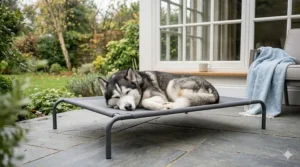
The Veehoo Elevated Bed brings elevated cooling to an accessible price point that won’t horrify your bank manager. Featuring an aluminium frame and breathable mesh fabric, this design lifts your Husky 18-23cm off the ground, allowing air to circulate underneath—the simplest and often most effective cooling method for thick-coated breeds.
For UK buyers, this bed’s true brilliance lies in its versatility. Use it outdoors in the garden during summer, then bring it indoors for winter when your Husky prefers elevation off cold tile floors. The mesh fabric dries quickly after those inevitable British downpours, and the assembly requires no tools—surprisingly useful when you’re dealing with a curious Husky trying to “help” with every step.
The frame supports up to 68kg (around 150 pounds for the large size), comfortably accommodating even hefty male Huskies. What most buyers don’t expect is how much Huskies instinctively gravitate toward elevated sleeping spots—it’s rooted in their ancestry, where raised positions offered better visibility and drainage in snowy terrain. The bed’s minimal padding means less heat retention, though some UK owners add a thin blanket during particularly cold winter nights.
Pros:
✅ Excellent airflow keeps Huskies cool in warm weather
✅ Quick-drying mesh perfect for British wet climate
✅ Tool-free assembly and lightweight for easy moving
Cons:
❌ Minimal cushioning—not ideal for senior Huskies with joint issues
❌ Frame can be noisy on hard floors when dog moves
Price & Verdict: Around £25-£45 depending on size. Remarkable value for money and genuinely effective cooling. The large size (107x81cm) provides ample space for stretching. Ships quickly via Amazon.co.uk Prime, often arriving within 24 hours in most UK regions.
4. Berkeley Pocket Spring Orthopaedic — Premium UK-Made Luxury
The Berkeley Pocket Spring Orthopaedic Bed represents British craftsmanship at its finest—and the price reflects that investment. Built using traditional mattress-making techniques with modern pocket spring technology, this bed provides dynamic response to your Husky’s body contours in ways that foam simply cannot match.
What distinguishes this for UK buyers is the construction: a central pocket spring core surrounded by four deep layers of cotton-rich felt, all wrapped in lamb’s wool and compressed inside a tough cotton drill inner. The springs create a natural thermo-regulating air dam that improves both insulation and breathability—genuinely clever engineering for a breed that needs temperature management year-round.
I’ve examined several Berkeley beds after years of use, and the quality justifies the investment. The pocket springs maintain their responsiveness, the felt layers don’t compress into uselessness like foam, and the overall structure survives the kind of enthusiastic flopping that destroys lesser beds within months. For older Huskies showing signs of hip dysplasia or arthritis—conditions common in the breed according to veterinary research on canine orthopaedic issues—this bed provides genuinely therapeutic support endorsed by Canine Arthritis Management UK.
The waterproof cover adds essential protection, though Berkeley recommends checking it every few months for wear. At 140x90x18cm, the XL size accommodates larger Huskies with room to spare, and the substantial 9.5kg weight means it stays put even when your Husky performs their pre-sleep circling routine.
Pros:
✅ Pocket springs provide dynamic support superior to foam
✅ Natural materials regulate temperature effectively year-round
✅ Genuinely orthopaedic construction backed by UK veterinary organisations
Cons:
❌ Significant investment at £180-£280
❌ Heavy weight (9.5kg) makes moving between rooms challenging
Price & Verdict: Around £180-£280 for the XL size. This is the bed for UK owners committed to long-term joint health, particularly for Huskies over five years old or those with confirmed orthopaedic issues. Whilst not typically available on Amazon.co.uk, Berkeley ships free throughout the UK. The five-year guarantee provides reassurance that few pet products offer.
5. Furhaven Cooling Gel Memory Foam — Combination Support and Cooling
The Furhaven Orthopedic Bed strikes a clever balance between supportive cushioning and active cooling technology. Beneath the plush microvelvet surface sits a layer of cooling gel-infused memory foam that helps regulate your Husky’s body temperature by dissolving heat away from the bed’s surface. The contoured design features a low centre that cradles your dog with sloped ends supporting the back and neck.
For British Husky owners, this bed’s strength lies in its dual-season versatility. The cooling gel remains effective even in modest UK summer temperatures, whilst the memory foam provides genuine joint support during damp winter months when arthritis symptoms often worsen. The five-inch thickness offers substantial cushioning without being so deep that senior Huskies struggle to climb in and out.
The removable cover handles machine washing admirably—essential during spring and autumn coat blows when your home transforms into a fur production facility. UK buyers particularly appreciate the charcoal base layer that helps absorb odours, rather useful for outdoor-loving Huskies who discover delightful smells during countryside walks. The bed’s rectangular shape (roughly 89x66cm in the large size) fits neatly against walls in typical British room layouts.
Pros:
✅ Gel-infused foam provides both cooling and orthopaedic support
✅ Contoured design supports natural sleeping positions
✅ Charcoal layer helps control odours from outdoor adventures
Cons:
❌ Memory foam can retain some heat compared to elevated designs
❌ Takes several days to fully off-gas new foam smell
Price & Verdict: Around £45-£70 depending on size. Excellent middle-ground option for UK Husky owners wanting supportive cushioning with active cooling. Available on Amazon.co.uk with Prime delivery to most UK postcodes. The large size suits the majority of Huskies, whilst the jumbo accommodates sprawlers.
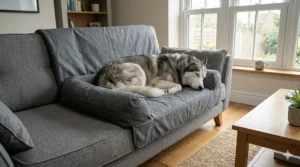
6. Kuranda Chew-Proof Elevated — For Destructive Chewers
The Kuranda Elevated Bed was engineered specifically to survive dogs whose definition of “bed” includes “chew toy.” Constructed with aircraft-grade aluminium framing and ballistic nylon fabric, this bed removes the primary chewing target—stuffing—whilst providing elevated cooling benefits.
What UK owners discover is that Kuranda’s oversized rails genuinely protect the fabric better than competing elevated beds. The frame sits 23cm off the ground, providing excellent airflow underneath whilst keeping your Husky off cold British floors during winter. The ballistic fabric is UV-treated and abrasion-resistant, making it suitable for conservatories and covered outdoor areas popular in British homes.
Assembly requires about 15 minutes and basic coordination—manageable even with a “helpful” Husky supervising. The bed supports up to 90kg on the large size, far exceeding what any Husky will test. Kuranda’s reputation amongst UK rescue organisations speaks volumes; shelters dealing with stressed, destructive dogs rely on these beds because replacements simply aren’t needed. The fabric can be replaced independently if it does eventually wear, extending the bed’s useful life considerably.
The elevated design means no cushioning beyond the suspended fabric, which some Huskies find less comfortable initially. Many UK owners report their Huskies eventually prefer it precisely because it stays cool and allows them to monitor their territory from a slightly raised position.
Pros:
✅ Genuinely chew-resistant construction survives destructive behaviours
✅ Elevated design provides excellent cooling airflow
✅ Replacement parts available—fabric can be changed independently
Cons:
❌ Premium pricing at £120-£180 for large sizes
❌ Minimal cushioning—not ideal for elderly Huskies with joint pain
Price & Verdict: Around £120-£180 for large sizes. This is the bed for UK Husky owners whose previous beds lasted measured in weeks rather than months. Whilst not always stocked on Amazon.co.uk, Kuranda ships to the UK with reasonable delivery times. The investment pays for itself by eliminating recurring replacement costs.
7. Silentnight Donut Bed — Best for Anxious Huskies
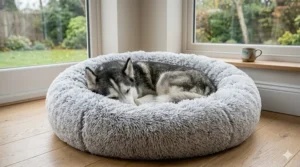
The Silentnight Donut Bed brings the expertise of Britain’s favourite sleep brand to canine comfort. Whilst Huskies don’t typically need the cosy enclosure that smaller breeds crave, this bed works beautifully for rescue Huskies or those with separation anxiety. The raised bolster creates a nest-like environment that many Huskies find reassuring, particularly younger dogs still settling into British homes.
Silentnight’s responsive fibre filling maintains its loft remarkably well—shake the bed after use and it genuinely bounces back to shape, unlike cheaper alternatives that flatten permanently within weeks. The entire bed is machine-washable at 40°C, which solves the inevitable challenge of keeping anything clean when you own a Husky. The non-slip backing works effectively on the laminate, tile, and vinyl flooring common in British kitchens and utility rooms.
What’s particularly clever for UK buyers is the colour range—navy, grey, and sage options coordinate with contemporary British home décor rather than screaming “dog bed” in garish patterns. The medium and large sizes (81cm and 91cm diameter respectively) accommodate most Huskies when curled, though sprawlers might find it constraining.
The donut design does trap more heat than flat or elevated alternatives, making this less suitable for Huskies prone to overheating. It’s the bed for colder British winter months or for Huskies who genuinely prefer enclosed sleeping spaces—you’ll know within the first night whether yours is that type.
Pros:
✅ Entire bed machine-washable—not just the cover
✅ Responsive filling maintains shape after repeated use
✅ Non-slip base actually works on British hard flooring
Cons:
❌ Enclosed design retains heat—unsuitable for warm months
❌ Not ideal for Huskies who prefer to sprawl whilst sleeping
Price & Verdict: Around £30-£50 depending on size. Excellent value from a trusted UK brand with genuine sleep expertise. Available on Amazon.co.uk with typically next-day Prime delivery. The large size (91cm diameter) suits most Huskies who enjoy curling up, whilst sprawlers should look elsewhere.
Understanding Husky Sleep Needs in British Homes
Siberian Huskies evolved in environments where temperatures rarely exceeded 15°C, creating specific physiological adaptations that British owners must understand. According to the Kennel Club’s breed information, their double coat consists of a dense, soft undercoat for insulation and longer guard hairs for protection—magnificent engineering for Siberian winters, considerably less brilliant for centrally heated British homes where indoor temperatures hover around 19-21°C year-round.
According to experts studying arctic breeds, Huskies’ ideal temperature ranges between 15-20°C, with discomfort starting above 25°C. This creates a unique challenge in British homes: whilst we rarely experience extreme heat, our indoor heating during autumn and winter can actually make Huskies uncomfortably warm. I’ve visited countless British homes where the Husky has abandoned their expensive plush bed to sleep on cold tile floors in the bathroom or kitchen—a clear signal that temperature management matters more than cushioning.
The digging and circling behaviour that destroys traditional beds isn’t destructiveness—it’s instinct. Huskies often dig and circle before lying down, creating a ‘nest,’ an instinct from their ancestors who dug snow beds. In Siberia, this behaviour created insulated sleeping hollows that protected against wind and extreme cold. In your semi-detached in Stockport, it shreds foam and tears fabric. Beds that accommodate this behaviour through durable materials or elevated designs that remove the digging target simply last longer.
British homes present additional considerations that American or Australian advice often overlooks. Our typically smaller rooms mean bed size matters—a sprawling American-style orthopedic bed that works beautifully in a Texas ranch house overwhelms a British terraced house bedroom. Our damp climate means waterproof protection isn’t optional, particularly during house-training or for senior Huskies with bladder control challenges. And our predominantly hard flooring requires non-slip bases that actually work, not the decorative rubber dots that slide across laminate at the first enthusiastic flop.
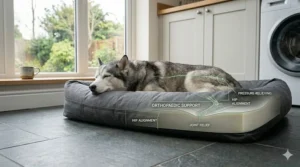
Real-World Scenarios: Matching Beds to British Husky Lifestyles
The London Flat Dweller
Sarah in Clapham faces challenges familiar to urban British Husky owners: a second-floor flat with limited outdoor space, no garden, and temperatures that climb uncomfortably during July and August. Her male Husky, Odin, spends most days indoors whilst she works, with exercise limited to early morning and evening walks in the nearby park.
For Sarah’s situation, the K&H Cool Bed III provides the most practical solution. The genuine cooling technology handles warm flat temperatures without electricity costs, crucial in London’s increasingly expensive rental market. The bed sits in her kitchen on tile flooring, where it can radiate heat both upward and downward. During winter, she supplements with the Veehoo Elevated Mesh, which keeps Odin off cold floors without the warm-weather overheating. The combination costs under £120 total and addresses both seasonal extremes effectively.
The Suburban Family in Manchester
The Johnsons in Didsbury have a three-year-old female Husky, Luna, who shares their semi-detached home with two young children. Luna has access to their modest garden but spends most time indoors, particularly during Manchester’s infamous rainy periods. The family’s central heating runs from October through April, making temperature management a nine-month concern.
The Bedsure Orthopedic Sofa serves this family brilliantly. The waterproof liner protects against inevitable accidents (child-spilled drinks, muddy paws from garden visits, the occasional house-training mishap). The machine-washable cover survives weekly cleaning during coat-blowing season. At £40 for the large size, it’s budget-friendly enough that replacing it every 18-24 months feels reasonable rather than painful. The four-sided bolster provides security when the children’s friends visit, giving Luna a retreat space whilst maintaining the approachable openness she needs for family integration.
The Rural Retiree in the Scottish Highlands
Malcolm in Inverness has a seven-year-old male Husky, Fergus, who’s beginning to show signs of hip stiffness after long walks. Their detached cottage offers ample space, a large garden, and access to countryside walks. However, the stone floors stay cold even with underfloor heating, and Fergus’s advancing age means joint support matters increasingly.
The Berkeley Pocket Spring Orthopaedic represents the right investment for Malcolm’s situation. The £260 price feels substantial, but Malcolm’s planning for Fergus’s senior years, potentially another 5-7 years. The pocket springs provide dynamic support that helps with Fergus’s hip stiffness, whilst the natural materials handle Scotland’s damp climate better than foam alternatives. The bed’s weight (9.5kg) means it stays in place on smooth stone floors, and the genuine orthopaedic construction has endorsement from Canine Arthritis Management UK—important as Fergus’s joint health becomes the priority.
Cooling Beds vs Orthopedic Support: What British Huskies Actually Need
The tension between cooling and cushioning represents the central challenge in selecting Husky beds for British conditions. Elevated mesh beds provide brilliant cooling but minimal joint support. Deep orthopedic foam offers excellent pressure relief but can trap heat. Understanding which matters more for your specific Husky requires honest assessment of their age, activity level, and health status.
For Huskies under four years old with no joint issues, prioritise cooling over cushioning. Young, healthy Huskies benefit far more from temperature regulation than from orthopaedic support they don’t yet need. The Veehoo Elevated Mesh or K&H Cool Bed III provides appropriate support for healthy joints whilst addressing their genuine temperature sensitivity. British homes rarely require both simultaneously for younger dogs.
Between four and seven years, consider combination solutions. This is when hip dysplasia and arthritis begin manifesting in predisposed Huskies—screening through your vet becomes worthwhile. Beds like the Furhaven Cooling Gel or Bedsure Orthopedic balance supportive cushioning with reasonable cooling, handling the transition period where joint health becomes relevant but temperature management remains important.
For Huskies over seven years or those with confirmed joint problems, orthopaedic support must take priority. Arthritis pain worsens in cold, damp British weather—precisely when cooling beds become least appropriate. The Berkeley Pocket Spring or high-quality memory foam options provide genuine therapeutic benefit. You can supplement cooling during warmer months with a separate cooling mat placed on top, giving flexibility that single-purpose beds cannot match.
The British climate actually simplifies this decision compared to extreme environments. We rarely experience heat that demands maximum cooling, nor cold that requires heated beds. Most UK Huskies thrive with moderately supportive beds that don’t trap excessive heat—the middle-ground options that would underwhelm in Arizona or Alaska work brilliantly in Birmingham or Belfast.
Waterproofing and Maintenance in the British Climate
Britain’s damp climate makes waterproof protection non-negotiable for Husky beds, and not just for obvious house-training reasons. Huskies love weather that sensible breeds avoid—they’ll bound gleefully through rain, splash through puddles, and roll in wet grass with enthusiasm that would embarrass a Labrador. Your “waterproof” bed needs to handle a soaking wet Husky flopping down with 25kg of damp fur and muddy paws.
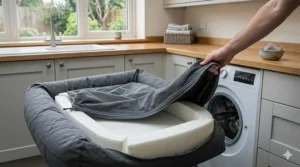
True waterproofing requires a barrier between the filling and the outer cover—ideally a separate waterproof liner that zips closed around the foam or filling. The Bedsure Orthopedic Sofa and Furhaven Cooling Gel both include this essential protection. Beds that claim “water-resistant covers” often fail within months when confronted with British realities: persistent drizzle, muddy gardens, and Huskies whose idea of drying off involves vigorous shaking directly onto their bed.
Maintenance frequency in British homes typically exceeds manufacturer recommendations. During coat-blowing season (spring and autumn), you’ll vacuum or lint-roll the bed almost daily. The cover needs washing fortnightly at minimum, weekly during peak shedding. This is why removable, machine-washable covers aren’t luxury features—they’re essential for British Husky ownership.
For outdoor or conservatory use, UV protection matters more than most realise. British summer sun, whilst rarely extreme, accumulates over months. Fabrics without UV treatment fade and weaken significantly faster than treated alternatives. The Kuranda Elevated includes UV treatment specifically for this reason, whilst budget alternatives often show sun damage within a single summer.
Drying presents its own challenges in British homes. We rarely have the consistent sunshine or low humidity that allows outdoor drying, and our smaller homes often lack the Americans’ luxury of dedicated laundry rooms. Beds with bulky foam inserts take days to dry completely indoors, creating mould risks. The Silentnight Donut’s entirely washable design solves this elegantly—chuck the whole thing in the machine, tumble dry on low, and it’s ready within hours rather than days.
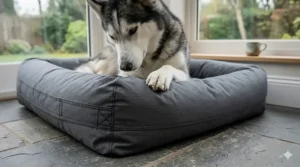
Common Mistakes When Buying Husky Beds in the UK
The most expensive mistake British Husky owners make is sizing down to fit British room dimensions. A bed that’s perfect for a Spaniel in your kitchen leaves a Husky cramped and uncomfortable, regardless of the manufacturer’s size chart. Measure your Husky from nose to base of tail whilst they’re stretched out—typically 60-75cm for females, 65-80cm for males—then add 15-20cm. Yes, the bed will dominate your kitchen. Yes, visitors will comment. No, there’s no way around this if you want your Husky to actually use it.
Choosing beds based on appearance rather than function represents another common pitfall. That gorgeous faux-fur plush bed that coordinates perfectly with your living room décor will become a £60 sweat box your Husky abandons for the cold bathroom floor. British home style magazines showcase dog beds as decorative elements; for Huskies, they’re temperature management equipment that happens to sit in your home. Function must lead, aesthetics follow.
Underestimating the importance of washability costs British owners repeatedly. A bed with a beautiful, non-removable cover becomes a hygiene nightmare during coat-blowing season. You’ll either pay for professional cleaning (easily £30-£50 each time) or replace the entire bed when it becomes too fur-matted and odorous to tolerate. The £15 you saved buying the non-washable version costs £100+ annually in cleaning or replacement.
Expecting one bed to serve all seasons sets up disappointment. Arctic breeds have opposite seasonal needs compared to most dogs. Your Husky needs cooling during warm months and elevation off cold floors during winter—rarely the same bed. Budget-conscious British owners get better value from two modest beds (one elevated mesh for summer around £35, one orthopedic for winter around £40) than one expensive all-season option that compromises both needs.
Ignoring the chewing habits of young Huskies or rescue dogs with anxiety creates the most preventable expense. That £80 premium orthopedic bed your eight-month-old Husky destroys in a fortnight represents poor planning, not bad luck. Destructive chewers need either elevated beds that remove the chewing target (Kuranda at £120 that lasts years) or cheap, replaceable options (Veehoo at £35 you replace without regret) until they mature past the chewing phase, typically around 18-24 months.
British Regulations and Safety Standards for Pet Beds
Whilst pet beds in the UK don’t face the same stringent regulation as human mattresses, responsible manufacturers increasingly seek UKCA marking for materials and comply with British safety standards. The UKCA (UK Conformity Assessed) marking replaced CE marking post-Brexit and indicates products meet UK safety, health, and environmental protection requirements.
Look for OEKO-TEX Standard 100 certification in bed covers and fabrics—this certification means every component has been tested against over 1,000 potentially harmful chemicals. The Bedsure range typically carries this certification, as do several other quality manufacturers. For foam-filled beds, CertiPUR-US certification indicates the foam contains no prohibited phthalates, heavy metals, formaldehyde, or ozone depleters—important when your Husky spends 12-14 hours daily in direct contact with these materials.
Fire retardant chemicals represent a particular concern for pet beds. Unlike human mattresses, pet beds aren’t legally required to contain fire retardants in the UK, yet some manufacturers include them anyway. According to research from UK veterinary toxicologists, long-term exposure to certain fire retardant chemicals may contribute to thyroid issues in dogs. The Berkeley specifically advertises that they never use fire retardant chemicals, whilst K&H products avoid them as company policy.
For outdoor or conservatory use, UV treatment becomes relevant under UK consumer safety guidelines. Fabrics that degrade in sunlight can create sharp edges or release deteriorating fibres—potential ingestion hazards for curious Huskies. Products from established manufacturers typically include UV stabilisers, though budget imports sometimes omit this protection.
The Consumer Rights Act 2015 protects UK buyers more robustly than American consumers enjoy. Pet beds must be “of satisfactory quality,” “fit for purpose,” and “as described.” If your bed falls apart within weeks despite normal use, you’re entitled to repair, replacement, or refund—your statutory rights extend beyond manufacturer warranties. Buying through Amazon.co.uk provides additional purchase protection, with returns accepted within 30 days for most items, often extending to 90 days during festive periods.
✨ Don’t Miss These Exclusive Deals!
🔍 Take your Husky’s comfort to the next level with these carefully selected products. Click on any highlighted item to check current pricing and availability on Amazon.co.uk. These picks will help you find exactly what your arctic companion needs!
How to Transition Your Husky to a New Bed
Introducing a new bed to a Husky requires more patience than with most breeds—they’re intelligent, stubborn, and surprisingly particular about their sleeping arrangements. The bed arrives, you place it hopefully in their usual sleeping spot, and your Husky regards it with the suspicion usually reserved for the vacuum cleaner.
Start by placing the new bed near where your Husky already prefers sleeping. If they’ve claimed the cold bathroom tiles, position the new cooling bed nearby rather than forcing immediate relocation. Leave their old bed (if it still exists) accessible initially—removing security before they’ve accepted the alternative creates resistance.
Scent transfer accelerates acceptance remarkably. Before removing packaging, rub one of your worn t-shirts over the new bed’s surface, then leave it there for 12-24 hours. Huskies trust familiar scents; your smell signals safety and acceptance. For rescue Huskies or those with anxiety, consider rubbing a cloth on the bed, then letting them carry it during a walk before returning it to the bed.
Never force your Husky onto the new bed or use it for time-outs or corrections. The bed must represent positive associations exclusively. Scatter high-value treats around and on the bed randomly throughout the day—not asking them to use it, just creating positive connections with its presence. When they investigate (curiosity will eventually triumph over suspicion), calmly praise without overwhelming enthusiasm that might spook them.
For elevated beds like the Veehoo or Kuranda, some Huskies need confidence-building. The unstable surface when first climbing on can startle them. Place the bed against a wall for stability, and use treats to reward any interaction—sniffing it, stepping on it with front paws, brief sits. Full lying down may take several days of gradual progress.
Temperature matters enormously for Husky bed acceptance. If you’re introducing a cooling bed during British winter when your Husky actually enjoys warmth, they’ll reject it regardless of your training efforts. Match bed introduction to appropriate seasons—cooling beds during May-September, orthopedic cushioned options during October-April.
Patience typically requires 3-7 days for straightforward transitions, potentially 2-3 weeks for rescue Huskies or those particularly attached to their old sleeping arrangements. The breakthrough often happens overnight—literally. You’ll wake up one morning to find your Husky has finally claimed their new bed as their own territory.
FAQ: Your Husky Bed Questions Answered
❓ How often should I replace my Husky's bed in the UK?
❓ Are elevated beds suitable for British winter temperatures?
❓ Can I use a heated bed for my Husky in the UK?
❓ Do XXL dog beds fit in typical British homes?
❓ What's the best bed for a Husky puppy in the UK?
Conclusion: Finding Your Husky’s Perfect British Bed
Selecting the right bed for your Siberian Husky in the UK ultimately comes down to honestly assessing your dog’s age, your home environment, and your budget constraints. The best bed isn’t always the most expensive option—it’s the one your Husky will actually use whilst surviving British conditions of damp, variable temperatures, and relentless fur shedding.
For most British Husky owners, the Bedsure Orthopedic Sofa represents the sweet spot of value, functionality, and durability at £35-£55. It handles our climate, survives machine washing, and provides reasonable support without trapping excessive heat. Budget-conscious buyers or those with young, non-destructive Huskies will find it serves brilliantly for 18-24 months before needing replacement.
If your Husky genuinely struggles with heat—common in flats and houses without adequate ventilation—the K&H Cool Bed III at £40-£75 provides genuine cooling technology that works in British summer conditions. For destructive chewers, the Kuranda Elevated at £120-£180 eliminates the cycle of replacement that ultimately costs more than the initial investment.
Senior Huskies with confirmed joint issues deserve the Berkeley Pocket Spring Orthopaedic at £180-£280. Yes, it’s expensive. Yes, it’s heavy. But if your Husky has given you years of loyal companionship and is now facing the challenges of arthritis in Britain’s damp climate, the therapeutic benefit justifies the investment.
Remember that your Husky’s needs will change throughout their life. The cooling bed that served brilliantly from ages 2-6 may need supplementing with orthopedic support as they enter their senior years. Budget for replacement and evolution rather than expecting one perfect bed to last a lifetime. British Husky ownership comes with costs—ensure the bed budget receives the priority it deserves. Your Husky spends half their life sleeping, after all. Making those hours comfortable is one of the most impactful investments you’ll make in their quality of life.
Recommended for You
- 7 Best Rottweiler Beds UK 2026: Giant Breed Joint Support
- 7 Best Boxer Dog Beds UK 2026: Orthopedic & Waterproof Picks
- Best Staffie Beds UK 2026: 7 Chew-Proof & Indestructible Options
Disclaimer: This article contains affiliate links. As an Amazon Associate, I earn from qualifying purchases. If you purchase products through these links, we may earn a small commission at no additional cost to you.
✨ Found this helpful? Share it with your mates! 💬🤗
