
In This Article
Your loyal companion spends roughly 12 to 14 hours each day sleeping—that’s more than half their life curled up in whatever bed you’ve provided. If that bed is a flattened cushion from three years ago or a basic polyester mat, their ageing joints are probably screaming for relief every morning. I’ve watched too many UK dog owners realise far too late that their Labrador’s sudden reluctance to climb stairs wasn’t just “getting old”—it was preventable joint deterioration accelerated by inadequate sleep support.
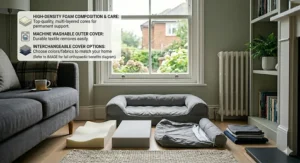
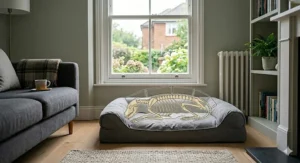
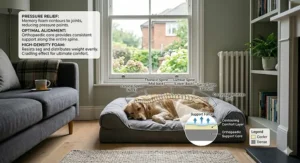
High density memory foam dog beds aren’t merely luxury items for pampered pooches. They’re therapeutic tools that distribute weight evenly across pressure points, reducing strain on hips, elbows, and shoulders whilst your dog rests. The “high density” specification matters enormously here: cheaper foam compresses quickly under weight, bottoming out within months and offering zero orthopaedic benefit. Genuine high density foam (typically 50-80 kg/m³) maintains its supportive structure for years, conforming to your dog’s body whilst providing the resistance necessary to keep joints properly aligned.
For Britain’s damp climate—where arthritis flare-ups worsen during our six-month drizzle season—a proper orthopaedic bed becomes even more critical. UK veterinary charities including PDSA and Blue Cross consistently recommend memory foam bedding as part of comprehensive arthritis management, particularly for breeds predisposed to hip dysplasia like German Shepherds, Labradors, and Golden Retrievers.
This guide examines seven high density memory foam dog beds currently available on Amazon.co.uk, focusing on products that deliver genuine therapeutic value rather than marketing fluff. I’ve prioritised UK availability, customer feedback from British pet owners dealing with our specific climate challenges, and beds that offer realistic long-term value in pounds spent per year of use.
Quick Comparison: Top High Density Memory Foam Dog Beds at a Glance
| Product | Foam Depth | Best For | Price Range | Prime Delivery |
|---|---|---|---|---|
| The Dog’s Bed Orthopaedic | 15cm total (5cm memory + 10cm support) | Severe arthritis, post-surgery recovery | £80-£150 | ✅ Yes |
| JOYELF Memory Foam Sofa | 7-10cm base | General joint support, anxious dogs | £40-£80 | ✅ Yes |
| KOPEKS Jumbo Orthopaedic | 18cm (with pillow) | Giant breeds, multiple large dogs | £100-£180 | ✅ Yes |
| Bedsure Orthopaedic Flat Mattress | 7.5cm dual-layer | Crate training, minimalist design | £35-£65 | ✅ Yes |
| Omlet Bolster Bed | 5cm memory foam | Style-conscious homes, rPET sustainability | £120-£200 | ✅ Yes |
| Baker & Bray Ultimate | 10cm orthopaedic foam | Eco-conscious buyers, senior dogs | £90-£160 | ✅ Yes |
| Silentnight Donut Calming | 8cm base | Anxiety + joint issues, nesting preference | £50-£90 | ✅ Yes |
From this comparison, The Dog’s Bed Orthopaedic offers the most robust therapeutic support for dogs with diagnosed joint conditions, whilst JOYELF provides the best value for preventative care in younger dogs or mild arthritis cases. UK buyers on a strict budget should note that Bedsure sacrifices bolster comfort for a lower price point, which works brilliantly for crate use but may disappoint dogs who enjoy nesting against raised edges. The premium options—Omlet and Baker & Bray—justify their higher cost through superior fabric durability and eco-certifications that matter if you’re keeping the bed for five-plus years.
💬 Just one click — help others make better buying decisions too! 😊
Top 7 High Density Memory Foam Dog Beds: Expert Analysis
1. The Dog’s Bed Orthopaedic Memory Foam Mattress
The gold standard for veterinary-approved orthopaedic support in the UK market, The Dog’s Bed Orthopaedic features a sophisticated dual-layer construction that mirrors human medical-grade mattresses. The top 5cm layer uses premium viscoelastic memory foam that responds to body heat, whilst the bottom 10cm comprises high-stability support foam (39/200 density rating) that prevents sagging even under heavy breeds.
What most buyers overlook about this model is its waterproof medical-grade PU fabric covering—not just water-resistant like cheaper alternatives. This matters enormously for senior dogs with occasional accidents or post-surgery incontinence issues. In practical terms, you can wipe down liquid spills immediately without worrying about foam contamination, and the material withstands cleaning with soap and water without degrading (avoid alcohol-based cleaners, which damage the PU coating).
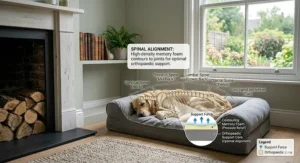
UK veterinary physiotherapists specifically recommend this bed for dogs recovering from cruciate ligament surgery or managing hip dysplasia. One verified Amazon.co.uk reviewer noted their 11-year-old Springer Spaniel with severe elbow arthritis stopped yelping when standing up after just four nights on this bed. The therapeutic effect comes from the foam’s ability to maintain spinal alignment whilst distributing weight away from inflamed joints—something standard beds simply cannot achieve.
Customer Feedback: British buyers consistently praise the bed’s performance through damp winters. Several reviewers in Scotland and Wales mentioned their dogs’ mobility improved noticeably during rainy months, when arthritis typically worsens.
Pros:
✅ Genuine medical-grade foam with dual-density construction
✅ Fully waterproof (not merely water-resistant) for easy hygiene
✅ Available in UK-themed covers including Union Jack designs
Cons:
❌ Takes 48-72 hours to fully expand after delivery
❌ Premium pricing may stretch budgets for multi-dog households
Price & Value: Available in the £80-£150 range depending on size. For severe joint conditions, this represents excellent value when compared to ongoing vet physiotherapy costs (typically £40-£60 per session in the UK).
2. JOYELF Memory Foam Dog Bed Sofa with Bolster
Consistently holding Amazon’s Choice badge for memory foam dog beds UK, JOYELF strikes a brilliant balance between therapeutic support and cosy comfort. The solid memory foam base measures 7-10cm depending on size selection, whilst generously padded bolsters filled with resilient PP cotton create that secure, nest-like environment anxious dogs crave.
The spec sheet won’t tell you this, but the JOYELF’s true strength lies in its non-slip rubber particle base—rather handy when you’ve got laminate flooring throughout your terraced house and your Cocker Spaniel does midnight zoomies. The bottom features dense rubber backing that grips smooth surfaces without adhesives, meaning the bed stays exactly where you’ve positioned it rather than sliding across the room during enthusiastic entry and exit.
Expert Perspective: This bed works exceptionally well for moderately active dogs aged 5-8 years showing early arthritis signs—that stage where they’re still playful but you’ve noticed they’re slower to stand after naps. The memory foam provides genuine joint relief without the hefty price tag of premium veterinary beds, making it sensible for preventative care rather than crisis management.
Customer Feedback: UK buyers particularly love the removable cover’s washing performance. Multiple reviewers mentioned the fabric maintained its shape and colour through 20+ machine washes, which matters when you’re dealing with muddy British spring walks.
Pros:
✅ Excellent value in the mid-price range (£40-£80)
✅ Robust zippers that withstand repeated washing
✅ Includes squeaker toy as bonus (though most dogs destroy it within days)
Cons:
❌ Bolsters compress faster than the base foam
❌ Not suitable for heavy chewers—seams are vulnerable
Price & Value: Around £40-£80 depending on size. Best value proposition for dogs without severe joint issues who need quality preventative support.
3. KOPEKS Jumbo Orthopaedic Memory Foam with Integrated Pillow
KOPEKS solves the perennial problem facing owners of Rough Collies, German Shepherds, Great Danes, and other substantial breeds: finding a bed that’s genuinely large enough. This beast measures 127cm × 86cm in the Extra Large configuration, with an impressive 18cm foam depth including a separate integrated headrest section.
The integrated pillow isn’t just a gimmick—it’s genuinely useful for dogs who naturally rest their heads elevated, which includes many large breeds with deep chests. What separates this from cheaper “large breed” beds is the foam quality throughout: hotel-grade memory foam that UK buyers report doesn’t flatten even after three years of daily use by two large dogs sharing the bed. That’s remarkable durability that justifies the premium pricing when calculated as cost-per-year.
Real-World Performance: The double-layer waterproofing system (inner waterproof liner plus outer moisture-resistant cover) provides peace of mind if you’re managing a senior dog with bladder control issues. The anti-slip base works well on British wood and tile floors, though several reviewers noted it’s heavy to move during house cleaning—a minor trade-off for stability.
Customer Feedback: Multiple Amazon.co.uk reviews from owners of two large dogs confirmed both pets comfortably share the XL size without territorial disputes.
Pros:
✅ Exceptional depth for heavy breeds (18cm total)
✅ Integrated pillow section for head elevation
✅ Demonstrable long-term durability (3+ years reported)
Cons:
❌ Significant weight makes it awkward to reposition
❌ Limited size options (only suitable for large/giant breeds)
Price & Value: £100-£180 depending on size. Expensive upfront but cost-effective over multi-year lifespan for large breed households.
4. Bedsure Orthopaedic Memory Foam Flat Mattress
For crate-trained dogs or those preferring minimal bedding designs, Bedsure delivers straightforward orthopaedic support without bolsters or unnecessary features. The dual-layer construction combines memory foam atop egg-crate support foam, providing effective pressure distribution across your dog’s body.
The egg-crate base layer—those distinctive wavy peaks and valleys—isn’t just for show. This design increases air circulation beneath your dog, reducing heat buildup during sleep. In practice, this matters more during British summer heatwaves (all three days of them) than you might expect, especially for thick-coated breeds like Huskies or Newfoundlands who overheat easily.
Practical Insight: The Bedsure fits standard UK crate dimensions perfectly, which cheaper Amazon mattresses often don’t. If you’ve purchased a medium crate from Pets at Home or similar UK retailers, this bed will slot in properly without bunching at the edges—a detail that sounds trivial until you’ve spent £35 on a bed that doesn’t fit.
Customer Feedback: British buyers with minimalist home aesthetics appreciate the low-profile design. Several reviewers noted their dogs transitioned from sleeping on sofas to using this bed consistently once placed in quiet corners.
Pros:
✅ Budget-friendly (£35-£65) for genuine memory foam
✅ Egg-crate design enhances breathability
✅ Perfect fit for standard UK crates
Cons:
❌ No bolsters for dogs who enjoy nesting against raised edges
❌ Flannel cover shows dirt quickly with light colours
Price & Value: Around £35-£65. Excellent budget option for crate use or dogs who don’t require bolster support.
5. Omlet Memory Foam Bolster Dog Bed
Omlet brings sustainability credentials and contemporary design to the orthopaedic dog bed market—rare combination in pet products. The memory foam mattress provides solid therapeutic support, whilst the angled bolster creates that perfect headrest position many dogs naturally seek.
What distinguishes Omlet in the UK market is their commitment to sustainable materials: rPET covers manufactured from recycled bottles, and GOTS-certified organic cotton cord options. If you’re environmentally conscious about pet products, this matters. The rPET fabric performs remarkably well too—soft enough for comfort, durable enough to withstand typical wear, and machine-washable in genuine sense (many “washable” covers emerge from machines looking defeated).
Design Philosophy: Omlet designed this bed with British homes in mind—smaller spaces where furniture serves multiple purposes. The contemporary prints and colour options actually complement modern interiors rather than screaming “dog bed.” If you’ve hesitated putting a dog bed in your living room because most look ghastly, Omlet solves that problem.
Customer Feedback: UK buyers praise the optional feet system that raises the bed for 360-degree airflow—particularly valuable in British ground-floor flats prone to damp. The elevation also helps older dogs enter and exit more easily.
Pros:
✅ Sustainable materials (rPET and GOTS organic cotton)
✅ Stylish designs that complement home décor
✅ Optional feet for raised airflow and damp prevention
Cons:
❌ Premium pricing (£120-£200) for mid-tier foam quality
❌ Spare covers expensive compared to competitors
Price & Value: £120-£200 depending on size and fabric choice. Best for buyers prioritising sustainability and aesthetics alongside moderate joint support.
6. Baker & Bray Ultimate Memory Foam Dog Bed
The Telegraph’s “Best Dog Bed” award winner for three consecutive years, Baker & Bray Ultimate combines orthopaedic memory foam with Scandi-inspired design and genuine eco-friendly credentials. The lower front edge—a thoughtful design detail often overlooked—makes entry significantly easier for small breeds and senior dogs with mobility limitations.
The fabric technology deserves specific mention: developed to resist snagging whilst maintaining softness, it withstands the scratching and digging behaviours many dogs exhibit before settling down. UK buyers with terriers, who are notorious bed-scratchers, particularly appreciate this durability. The fabric feels luxurious but isn’t delicate—rather important when your dog’s pre-sleep routine involves five minutes of enthusiastic excavation.
UK Context: Baker & Bray operates as a British brand, meaning replacement covers and customer service operate on UK time zones and dispatch from UK warehouses. When you need a replacement cover urgently because your dog’s had an unfortunate accident, next-day delivery actually means next day—not “dispatched from an EU warehouse in 5-7 working days.”
Customer Feedback: Multiple verified buyers mentioned their dogs gravitated immediately to this bed, suggesting the combination of memory foam support and generous bolster padding creates genuine comfort rather than just theoretical orthopaedic benefits.
Pros:
✅ Telegraph-awarded quality (independently verified)
✅ Anti-snag fabric withstands scratching behaviours
✅ Low entry height aids senior dog mobility
Cons:
❌ Premium pricing approaching £160 for larger sizes
❌ Limited colour options compared to mass-market alternatives
Price & Value: £90-£160 depending on size. Premium investment justified by exceptional durability and award-winning design.
7. Silentnight Calming Donut Memory Foam Bed
Silentnight cleverly combines calming bed design with genuine orthopaedic support, addressing the reality that many arthritic dogs also suffer anxiety—particularly rescue dogs or those with separation issues. The raised doughnut rim provides 360-degree support for nesting, whilst the memory foam base delivers therapeutic joint relief.
The deep crevice design triggers natural denning instincts, which explains why even dogs who typically ignore beds will immediately claim this one as their territory. In practical terms for British households, this becomes the bed your dog actually uses consistently rather than abandoning for the sofa after three days.
Practical Performance: The entire bed machine-washes successfully—rare achievement for large memory foam beds, where most manufacturers specify “spot clean only” because the foam can’t withstand washing machines. Silentnight’s construction allows the whole assembly to survive British washing machines set to 30°C, emerging intact and maintaining shape after air-drying.
Customer Feedback: UK buyers with anxious dogs report noticeable behavioural improvements—less pacing at bedtime, reduced stress barking when left alone briefly, improved sleep quality visible in calmer morning behaviour.
Pros:
✅ Dual benefit: calming design + orthopaedic support
✅ Entire bed machine-washable (not just cover)
✅ Excellent customer rating (4.4 stars, 1,600+ reviews UK)
Cons:
❌ Raised rim may not suit dogs who prefer flat sleeping
❌ Takes considerable drying time after washing
Price & Value: £50-£90 depending on size. Outstanding value for dogs requiring both joint support and anxiety management.
Real-World Scenario: Matching the Right Bed to Your Dog’s Needs
The London Flat Dweller with a Senior Spaniel
Situation: Emma lives in a Zone 2 one-bedroom flat with her 10-year-old Springer Spaniel, Jasper, who’s developed mild hip arthritis. Space is limited, floors are laminate throughout, and she needs something washable given Jasper’s muddy walks along the Regent’s Canal.
Best Match: JOYELF Memory Foam Sofa (Medium size, around £55)
Reasoning: The non-slip base grips Emma’s laminate floors perfectly, preventing the midnight sliding episodes that woke her when Jasper entered/exited his old bed. The memory foam provides adequate therapeutic support for mild arthritis without the premium cost of veterinary-grade options. The removable cover survives weekly washing—essential when canal walks leave Jasper caked in Thames-adjacent mud. The bolstered sides give Jasper the secure feeling he craves in the confined flat environment.
The Multi-Dog Household in Rural Yorkshire
Situation: The Thompsons own two large Rough Collies (aged 6 and 8) in a converted barn in the Dales. Both dogs share sleeping spaces naturally, and the family prioritises longevity over initial cost given previous experience with beds flattening within 18 months.
Best Match: KOPEKS Jumbo Orthopaedic (Extra Large, around £165)
Reasoning: The 127cm × 86cm dimensions genuinely accommodate two large dogs without territorial disputes. The 18cm foam depth withstands the combined weight long-term—critical when previous beds collapsed under dual-dog pressure within a year. The integrated pillow section suits the Collies’ preference for elevated head sleeping. Calculated as cost-per-year over a projected 4-year lifespan, the KOPEKS works out cheaper than replacing budget beds annually.
The Eco-Conscious Professional in Edinburgh
Situation: Sarah works from her Morningside flat with her 7-year-old Border Collie, Bonnie, visible in video calls. She needs a bed that looks presentable in professional settings whilst supporting Bonnie’s early-stage arthritis, preferably with environmental credentials.
Best Match: Omlet Memory Foam Bolster (Medium, around £145 in rPET fabric)
Reasoning: The Omlet’s contemporary design in muted colours actually enhances Sarah’s home office aesthetic rather than detracting from it. The rPET fabric satisfies her environmental standards whilst performing practically. The optional feet raise the bed off Edinburgh’s cold stone floors—important in a Victorian conversion flat where ground-level damp is perpetual. Bonnie gets genuine orthopaedic support, and Sarah’s clients see an attractive piece of pet furniture rather than a garish eyesore during Zoom calls.
How to Choose the Right High Density Memory Foam Dog Bed for Your UK Home
Selecting a high density memory foam dog bed involves more than checking price tags and clicking “add to basket.” British pet owners face specific considerations that American buying guides completely miss—from our compact housing stock to our persistently damp climate. Here’s how to make an informed decision:
1. Measure Your Dog Properly (And Add 25%)
Most UK homes have limited floor space, but undersizing a dog bed creates false economy. Measure your dog from nose to tail base whilst they’re stretched out sleeping, then add 25% to that length. A 60cm Cocker Spaniel needs a minimum 75cm bed length—anything smaller forces them to curl uncomfortably, defeating the orthopaedic purpose entirely. For width, measure shoulder-to-shoulder and add 30cm. British breeds like Border Collies and Springer Spaniels naturally sprawl sideways when deeply asleep; cramping that spread increases joint pressure rather than relieving it.
2. Understand Foam Density Specifications
“High density” isn’t regulated terminology, meaning manufacturers apply it liberally to any foam slightly firmer than marshmallow. Genuine high density memory foam for therapeutic use should meet 50-80 kg/m³ density. Budget beds claiming “memory foam” often use 25-35 kg/m³ material that compresses flat within months. The Dog’s Bed and KOPEKS specify their foam density ratings; brands that don’t publish these figures are typically hiding inferior materials.
3. Account for British Climate Realities
Our weather pattern—damp nine months yearly, briefly sunny three months—affects dog bed performance significantly. Waterproof (not water-resistant) inner liners become essential for senior dogs, as bladder control often deteriorates during British winter when dogs drink more to stay warm. Beds raised on feet (like Omlet) combat ground-level damp common in Victorian terraces and ground-floor flats. Breathable covers matter less here than in Mediterranean climates; focus on washability instead, given the mud-caked reality of British dog ownership.
4. Calculate Cost-Per-Year Rather Than Purchase Price
A £40 bed replaced annually for three years costs £120 total. A £120 bed lasting five years costs £24 annually—five times better value despite higher upfront cost. Quality indicators predicting longevity include: dual-layer foam construction, foam density specifications actually published, removable covers with robust YKK zippers, waterproof inner liners as standard. British buyers often fixate on purchase price, missing that premium beds frequently outlast budget options by 3:1 ratios.
5. Match Foam Depth to Dog’s Weight and Age
Lightweight dogs (under 10kg) need 5-7cm foam minimum; medium breeds (10-25kg) require 7-10cm; large breeds (25-40kg) need 10-15cm; giant breeds (40kg+) demand 15cm+ depths. These aren’t arbitrary numbers—they reflect the foam compression under body weight necessary to provide support without bottoming out. A 35kg Labrador on a 7cm bed will compress the foam completely, essentially sleeping on the floor with token padding. The KOPEKS’ 18cm depth isn’t excessive for German Shepherds; it’s appropriate engineering.
6. Consider Your Living Space Configuration
Flat dwellers in Manchester, Edinburgh, or London face different requirements than rural homeowners. Terraced housing typically features laminate or tile throughout—non-slip bases become essential rather than optional features. Apartments with only one quiet corner must accommodate the dog bed there; measure available space before selecting sizes. Crate-trained dogs need beds fitting standard UK crate dimensions (Bedsure excels here). Open-plan living requires beds that don’t visually assault your décor (Baker & Bray and Omlet address this).
7. Assess Washing Practicality
British dogs get muddy. That’s not pessimism; it’s geography. Your chosen bed will need washing fortnightly during autumn/winter, possibly weekly in spring. Removable covers are non-negotiable, but verify they survive actual machine washing rather than emerging looking worse than before. The JOYELF and Silentnight both handle 30°C washing admirably; cheaper alternatives often pill, fade, or shrink after three washes. Check if replacement covers are available and affordably priced—Omlet’s spare covers cost nearly half a new bed’s price, which rather undermines the sustainability angle.
Common Mistakes When Buying Memory Foam Dog Beds UK
Mistake #1: Ignoring UKCA Certification and Safety Standards
British buyers should verify foam products meet UK safety standards post-Brexit. OEKO-TEX® STANDARD 100 certification ensures the foam and fabrics have been tested against over 1,000 potentially harmful chemicals. Several Amazon.co.uk listings feature products manufactured for the US or EU market without proper UK certification. Whilst unlikely to cause immediate harm, these products may not comply with UK fire safety regulations—rather important given the number of house fires attributed annually to unsafe pet bedding.
Mistake #2: Assuming “Orthopaedic” Means “Memory Foam”
Marketing departments love the word “orthopaedic” because it sounds medical and justifies higher pricing. Many beds marketed as orthopaedic contain standard polyurethane foam with zero memory properties. Genuine memory foam (viscoelastic polyurethane) responds to body heat and pressure, conforming to your dog’s shape before slowly recovering when pressure releases. Test this by pressing your palm firmly into the foam—if it bounces back instantly, it’s not memory foam regardless what the listing claims. True memory foam takes 5-10 seconds to return to original shape.
Mistake #3: Underestimating British Dogs’ Destructive Capabilities
We’ve all watched those wholesome videos of dogs gently entering their beds and settling peacefully. British terriers missed that memo. Many UK breeds—Jack Russells, Border Terriers, Westies—instinctively dig and scratch before lying down. Buying a bed with delicate fabrics or exposed seams invites destruction. The Baker & Bray’s anti-snag fabric isn’t marketing hyperbole; it’s practical engineering acknowledging that British working breeds have strong nesting behaviours inherited from centuries of ratting and badger work.
Mistake #4: Prioritising Aesthetics Over Practicality for Senior Dogs
That gorgeous raised bed with the ornate wooden frame looks smashing in your Cotswolds cottage, but your 12-year-old Labrador with hip dysplasia can’t comfortably climb into it anymore. Senior dogs need low entry heights (under 15cm from floor) and firm foam that doesn’t sink dramatically when stood upon—sinking creates instability that arthritic dogs find frightening. The Baker & Bray’s deliberately lower front edge addresses this; pretty beds with uniform-height sides often don’t.
Mistake #5: Forgetting About British Electrical Standards
Some premium dog beds now include heating elements for therapeutic warmth. If purchasing these, verify they use UK plugs (Type G, three-pin) and operate on 230V/50Hz rather than requiring voltage converters. Several Amazon.co.uk listings sell US-specification heated beds (110V) without clearly stating this limitation. Using these with converters adds unnecessary failure points and potential fire hazards. Stick to UK-manufactured heating elements or simple unheated foam beds.
Mistake #6: Believing All Amazon Prime Products Ship Immediately
Amazon.co.uk Prime offers next-day delivery on items dispatched from UK warehouses, but many “Prime-eligible” pet products actually ship from European warehouses post-Brexit, meaning 5-7 day delivery despite the Prime badge. If your dog needs a replacement bed urgently (perhaps their current bed split overnight), check the delivery estimate carefully rather than assuming Prime automatically means immediate arrival. UK-based brands like The Dog’s Bed and Baker & Bray typically ship faster for British buyers.
Long-Term Cost & Maintenance: What UK Buyers Need to Know
Initial Investment vs Annual Costs
High density memory foam dog beds represent significant upfront expenditure—£80-£180 isn’t trivial for most British households. However, the total cost of ownership calculated over a bed’s realistic lifespan reveals different economics than purchase price alone suggests.
Budget Bed Scenario (£35-£50 beds):
- Initial purchase: £40
- Replacement year 2: £40
- Replacement year 3: £40
- Three-year total: £120
- Annual cost: £40
Premium Bed Scenario (£120-£160 beds):
- Initial purchase: £140
- Foam still supportive year 3: £0
- Foam still supportive year 5: £0
- Five-year total: £140
- Annual cost: £28
The premium bed costs 30% less annually whilst providing superior therapeutic value throughout its lifespan. This calculation assumes proper maintenance; neglected premium beds fail prematurely just as budget beds do.
Maintenance Schedule for Maximum Lifespan
Weekly Tasks:
- Remove loose hair with rubber brush or vacuum attachment (prevents hair embedding in fabric)
- Check cover integrity for developing tears or zipper stress
Fortnightly Tasks:
- Remove and wash cover at 30°C on gentle cycle (hot water damages waterproof coatings)
- Air the foam base outdoors for 2-3 hours in dry weather (moisture accumulation degrades foam faster)
- Inspect foam for compression areas that aren’t recovering
Quarterly Tasks:
- Deep clean cover (if machine-washable at 40°C, do so quarterly rather than regularly)
- Rotate foam if design allows, distributing compression wear
- Apply fabric protector spray to cover (extends water resistance)
Replacement Part Economics
Smart manufacturers design beds with replaceable components, reducing long-term ownership costs. The Dog’s Bed offers replacement covers for around £25-£40, meaning you can refresh appearance without replacing the entire foam base when covers wear out after 2-3 years. Omlet similarly sells spare covers, though at higher prices (£45-£70). Budget brands typically don’t offer replacement parts—when the cover fails, you buy an entirely new bed.
This modular approach particularly benefits UK households with muddy-pawed dogs who destroy covers faster than foam wears out. A £35 replacement cover extends a £120 bed’s life by 2-3 years, costing £11-£17 annually compared to £40-£50 for repeated budget bed purchases.
Understanding Memory Foam: The Science Behind Better Sleep
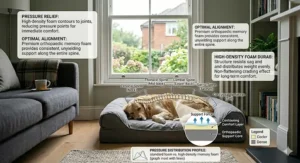
Memory foam’s therapeutic properties stem from its viscoelastic structure—a material originally developed by NASA in the 1960s for aircraft cushions. When your dog lies on genuine memory foam, their body heat softens the polymer structure, allowing it to conform precisely to their unique body shape. This contouring distributes weight across a larger surface area, reducing pressure on specific points (hips, elbows, shoulders) where arthritis typically develops first.
The Kennel Club notes that orthopaedic bedding forms part of effective arthritis management alongside weight control and appropriate exercise. The foam’s pressure-distributing properties mean joints aren’t supporting the dog’s full weight whilst resting—critical for conditions like hip dysplasia where excessive joint loading accelerates cartilage deterioration.
Temperature Sensitivity Considerations:
Memory foam performs differently across temperature ranges. In cold British winter bedrooms (12-15°C), the foam remains firmer, providing more resistance. During warmer months (20-25°C), the same foam softens considerably, conforming more readily. This isn’t a defect—it’s inherent to viscoelastic materials. Premium foams like those in The Dog’s Bed are formulated with narrower temperature-response ranges, maintaining consistent support across Britain’s temperature fluctuations better than budget alternatives engineered for Mediterranean climates.
Foam Degradation Patterns:
High quality memory foam doesn’t suddenly collapse; it degrades gradually over 4-6 years. You’ll notice compression recovery slowing first—the foam takes progressively longer returning to original shape after your dog stands. Next, permanent compression zones develop where your dog’s heaviest body parts (typically shoulders and hips) rest consistently. Once compression recovery exceeds 30 seconds, therapeutic value diminishes significantly and replacement becomes advisable.
FAQ: Your High Density Memory Foam Dog Bed Questions Answered
❓ How thick should memory foam be for a dog with arthritis?
❓ Can puppies use high density memory foam beds?
❓ How long do quality memory foam dog beds last in UK conditions?
❓ Are memory foam dog beds worth the cost for joint issues?
❓ What's the difference between memory foam and orthopaedic foam?
Conclusion: Investing in Your Dog’s Joint Health for Life
High density memory foam dog beds aren’t indulgent luxuries—they’re preventative healthcare investments that pay dividends through your dog’s senior years. Britain’s ageing dog population increasingly faces mobility challenges exacerbated by our damp climate, making proper orthopaedic support more critical than ever. The seven beds analysed here represent genuine therapeutic options available to UK buyers through Amazon.co.uk, each addressing different needs and budgets whilst delivering measurable joint support.
The Dog’s Bed Orthopaedic remains my top recommendation for dogs with diagnosed joint conditions requiring veterinary-grade support. Its dual-density construction and medical-grade waterproof covering justify the premium pricing through superior therapeutic performance and exceptional durability. For preventative care in younger dogs or mild arthritis cases, JOYELF offers outstanding value, combining genuine memory foam support with practical features UK households actually need—washability, non-slip backing, and robust construction surviving British mud season.
Giant breed owners should seriously consider KOPEKS, whose 18cm depth and generous dimensions finally provide adequate support for substantial dogs. Budget-conscious buyers will find Bedsure delivers legitimate orthopaedic benefits without financial strain, though you sacrifice bolster comfort and aesthetic refinement. Eco-conscious professionals might justify Omlet or Baker & Bray’s premium pricing through sustainability credentials and design sophistication.
Whatever your choice, remember that effective arthritis management requires multiple interventions—appropriate bedding, weight management, controlled exercise, and veterinary oversight working together. PDSA and Blue Cross offer comprehensive UK-specific guidance on holistic joint care approaches. A quality memory foam bed forms one crucial component of that strategy, providing 12-14 hours daily of therapeutic support your loyal companion genuinely deserves.
Investing £80-£160 today potentially adds years of comfortable mobility to your dog’s life—rather good value when measured against the immeasurable worth of their companionship.
Recommended for You
- 7 Best Jumbo Dog Beds UK 2026 – Giant Breed Reviews
- Two Dog Beds: 7 Expert-Tested Options for UK Multi-Pet Homes 2026
- Giant Breed Dog Beds: 7 Best XXL Options for UK Dogs (2026)
Disclaimer: This article contains affiliate links. As an Amazon Associate, I earn from qualifying purchases. If you purchase products through these links, we may earn a small commission at no additional cost to you.
✨ Found this helpful? Share it with your mates! 💬🤗
