
In This Article
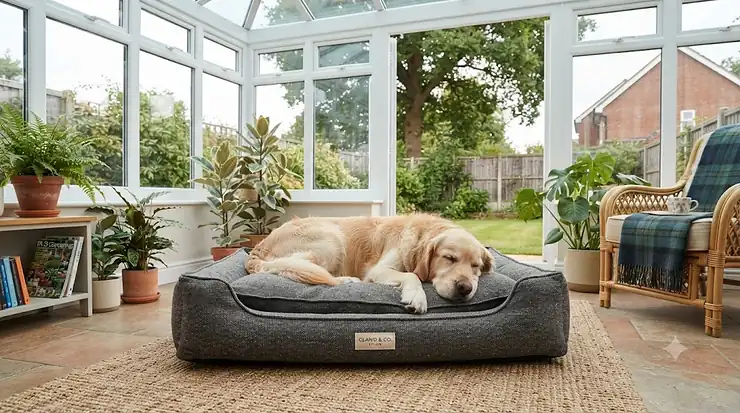
There’s a particular kind of chaos that happens the moment the sun hits a conservatory roof. Within twenty minutes, a room that felt perfectly pleasant at breakfast has turned into something closer to a greenhouse, and your dog — who was blissfully snoozing on the tiles ten minutes ago — is now panting by the door like they’ve just run a 5K. Anyone who’s lived with a conservatory knows this dance intimately: the space is glorious in spring and autumn, borderline hostile in August, and bracingly cold come January. Choosing a dog bed for conservatory use isn’t quite the same task as picking a bed for the living room. You’re not just buying comfort — you’re buying temperature regulation, UV resistance, and a bit of insurance against a room with a mind of its own.
This guide walks through seven real, currently available beds that are genuinely suited to conservatory conditions, from budget-friendly raised cots to a properly plush orthopaedic option for older dogs. Along the way, we’ll dig into conservatory flooring types, how to design a pet-friendly room that doesn’t sacrifice style, and — critically — where to actually position the bed so your dog isn’t cooking in a sunbeam by mid-morning. A dog bed for conservatory use, in short, needs elevation for airflow, breathable or washable fabric, and enough structural give to survive both a heatwave and a cold snap. Get that right, and the conservatory stops being a room your dog avoids and starts being their favourite spot in the house.
Quick Comparison Table
| Product | Type | Best Suited To | Price Bracket | Best For |
|---|---|---|---|---|
| Amazon Basics Raised Dog Bed | Elevated mesh cot | All sizes, all seasons | Under £45 | Best overall value |
| Bunty Sided & Raised Dog Bed | Raised, sided cot | Small-medium breeds | Around £25 | Tightest budget |
| Bedsure Elevated Dog Bed | Raised outdoor-grade cot | Large breeds | £35-£60 range | Big dogs, sunroom edges |
| K&H Pet Products Coolin’ Cot | Elevated mesh with accessories | Senior/arthritic dogs | £38-£63 range | Joint support + airflow |
| iNap Raised Dog Bed | Folding orthopaedic cot | Multi-room, portable use | Mid-£30s to £50s | Year-round flexibility |
| Scruffs Cool Grey Dog Bed | Cooling gel-effect mat/bed | Indoor lounging | £16-£49 range | Passive cooling comfort |
| Trixie Vital Bed Noah | Orthopaedic memory foam bed | Older dogs, joint issues | £70-£90 range | Premium comfort pick |
Looking at the spread here, the pattern that jumps out is elevation — five of the seven products lift your dog off the floor, and that’s not a coincidence given how quickly conservatory flooring absorbs and radiates heat. The Trixie Vital Bed Noah breaks that mould slightly, prioritising joint support over airflow, which makes it a smarter pick for a conservatory that’s properly insulated or gets heavy shade. Budget shoppers should note that the Bunty Sided & Raised Dog Bed and Amazon Basics Raised Dog Bed deliver very similar functional benefits at a fraction of what you’d pay for the mid-range cots, though the trade-off tends to show up in long-term durability rather than day-one comfort.
💬 Just one click — help others make better buying decisions too!😊
Top 7 Dog Beds for Conservatory Living: Expert Analysis
1. Amazon Basics Raised Dog Bed — best all-round value for conservatory use
The Amazon Basics Raised Dog Bed has quietly become something of a default recommendation among UK dog owners furnishing sunrooms and conservatories, and it earns that reputation through sheer practicality rather than flash. The bed sits on a powder-coated iron frame that lifts your dog 19-23cm off the ground, which matters enormously in a conservatory — floor-level heat can be dramatically hotter than the air just a few inches above it, so that gap does real work. The breathable mesh fabric is OEKO-TEX certified, meaning it’s been tested against harmful substances, which is reassuring for a bed that’ll spend a lot of time in direct sun. Based on the spec comparison with pricier rivals, this bed delivers nearly identical elevation and airflow benefits for roughly half the outlay, making it the sensible starting point for anyone who isn’t sure yet how their dog will take to conservatory living. Reviewers consistently note that the frame holds up well even with larger, more boisterous dogs clambering on and off throughout the day, though a small number mention the fabric sagging slightly after a year or two of heavy use. It’s available across five sizes, so fitting it to a compact conservatory corner or a sprawling garden-room footprint is straightforward either way.
Pros:
- ✅ Excellent airflow from 19-23cm elevation
- ✅ OEKO-TEX certified breathable mesh fabric
- ✅ Five sizes available from XS to XL
Cons:
- ❌ Fabric can sag with heavy, prolonged use
- ❌ No canopy option for shaded corners
Sitting comfortably under £45 depending on size, this remains one of the strongest value propositions on the list — a genuinely sound starting point rather than a compromise.
2. Bunty Sided & Raised Dog Bed — lowest-cost entry into elevated cooling
If your budget is the main constraint, the Bunty Sided & Raised Dog Bed is where most conservatory shoppers land first, and it’s easy to see why. It follows the same elevated-cot logic as pricier alternatives — raised legs, breathable base — but adds low sides that give smaller dogs something to lean against, which some pups genuinely prefer over a flat, exposed platform. What most buyers overlook about sided beds like this one is that the sides also help contain shed fur and dirt, a small but genuinely useful bonus in a room with tiled or hard flooring where debris tends to migrate everywhere. Aggregated review sentiment suggests owners are largely happy with the price-to-comfort ratio, particularly for smaller breeds, though several reviewers flag that extra-large or heavy dogs can strain the frame over time. It’s a sensible pick for a first-time conservatory bed while you work out whether your dog actually takes to the space, without committing to a premium spend before you know that.
Pros:
- ✅ Very accessible price point for elevated cooling
- ✅ Low sides help contain shed fur and mess
- ✅ Easy to wipe down after muddy paws
Cons:
- ❌ Frame less suited to extra-large or heavy dogs
- ❌ Limited size range compared with rivals
At around £25, this is about as low-commitment as a genuinely functional elevated bed gets — a smart trial run before scaling up.
3. Bedsure Elevated Dog Bed — best for large breeds near glass walls
Big dogs generate more body heat than small ones, plain and simple, which makes the Bedsure Elevated Dog Bed worth a closer look if you’re furnishing for a Labrador, a Shepherd, or anything in that size bracket. This raised cot is built with outdoor-grade materials — a rust-resistant frame and a tightly woven fabric designed to withstand both moisture and repeated sun exposure — which is a genuinely practical fit for placement near the glazed panels typical of a conservatory. What the spec sheet won’t tell you, but reviewers note, is that the wider stance of this bed makes it noticeably more stable for dogs that like to hop on and off with some force, rather than settling in gently. That structural steadiness is arguably the standout feature here, more than the raw cooling performance, which is broadly comparable to the cheaper options on this list. Owners of larger dogs report good longevity from the frame, though a handful mention that the fabric can develop small tears if a dog is a persistent scratcher before settling.
Pros:
- ✅ Outdoor-grade, rust-resistant frame construction
- ✅ Wide, stable stance suited to larger dogs
- ✅ Tightly woven fabric resists moisture well
Cons:
- ❌ Fabric can tear under persistent scratching
- ❌ Bulkier footprint needs more floor space
Priced in the £35-£60 range depending on size, it represents solid mid-tier value specifically for households with a bigger dog to accommodate.
4. K&H Pet Products Coolin’ Cot Elevated Dog Bed — best for senior or arthritic dogs
Older dogs often struggle most with conservatory extremes — stiff joints don’t love cold tile in winter, and reduced mobility makes it harder for them to move themselves out of a hot patch of sun. The K&H Pet Products Coolin’ Cot Elevated Dog Bed addresses this through its elevated mesh design, which keeps a senior dog’s joints off punishing hard flooring while still allowing the airflow that prevents overheating in summer. Based on the spec comparison with basic elevated cots, the standout advantage here is compatibility with additional accessories — owners can add a canopy or a heated pad depending on the season, effectively turning one frame into a year-round solution rather than buying separate summer and winter beds. Reviewers consistently highlight how easy the assembly process is, a detail that matters more than it sounds when you’re setting up furniture in a room with awkward angles and sloped glazing. A common complaint in user reviews is that the accessories are sold separately and add up in cost, so it’s worth budgeting for the full set-up rather than just the base cot.
Pros:
- ✅ Compatible with add-on canopy and heating accessories
- ✅ Genuinely easy, tool-light assembly
- ✅ Elevated mesh eases pressure on ageing joints
Cons:
- ❌ Accessories sold separately, adding to total cost
- ❌ Frame feels less premium than the Bedsure
Sitting in the £38-£63 range before accessories, this is best thought of as a modular system rather than a one-off purchase — but a genuinely thoughtful one for older dogs.
5. iNap Raised Dog Bed with Folding Legs — best for year-round versatility
Few beds on this list handle the conservatory’s split personality — sweltering in July, freezing in January — as gracefully as the iNap Raised Dog Bed with Folding Legs. Its orthopaedic steel frame provides the elevation needed for summer airflow, while the raised structure itself creates a buffer against cold floors in winter, a genuinely clever bit of dual-purpose design that a lot of single-season beds miss entirely. The collapsible legs are the other headline feature, and honestly, they’re more useful than they first sound: being able to fold the bed flat means you can move it between the conservatory and a warmer room during a proper cold snap without wrestling a bulky frame through a doorway. Reviewers rate it strongly overall, with particular praise for the washable breathable fabric holding its shape wash after wash. On the downside, some owners note the folding mechanism takes a bit of getting used to and isn’t the sturdiest hinge on the market, so it’s not one to fold and unfold daily without some care.
Pros:
- ✅ Genuinely functional in both hot and cold extremes
- ✅ Collapsible legs make relocating the bed simple
- ✅ Washable fabric holds shape over repeated washes
Cons:
- ❌ Folding hinge feels a little flimsy long-term
- ❌ Not the cheapest option in its category
Typically priced from the mid-£30s into the £50s depending on size, this is arguably the smartest all-rounder if you only want to buy one bed for the whole year.
6. Scruffs Cool Grey Dog Bed — best passive cooling for indoor lounging
Not every dog wants to be perched on an elevated cot — plenty prefer to sprawl properly on something closer to the ground, and that’s where the Scruffs Cool Grey Dog Bed comes in. Rather than relying purely on elevation, it uses a cooling gel-effect fabric that activates under your dog’s body weight, drawing heat away passively without needing any airflow underneath at all. This makes it a strong option for conservatories with limited floor clearance or awkward furniture arrangements where a raised cot simply won’t fit comfortably. Independently tested and rated as a top overall cooling pick by UK reviewers, it’s earned a reputation for genuinely noticeable temperature reduction rather than marketing-only “cooling” claims that don’t actually do much. Reviewers consistently note the plush, low-profile design suits older or smaller dogs who find it harder to climb onto raised platforms, though a few point out that it’s less effective once ambient room temperature climbs into truly extreme territory, since it’s cooling the dog relative to their own body heat rather than actively refrigerating the surface.
Pros:
- ✅ Independently rated among the best cooling beds
- ✅ Low profile suits dogs who avoid climbing onto cots
- ✅ Genuinely effective gel-based passive cooling
Cons:
- ❌ Less effective in truly extreme heat
- ❌ No elevation benefit against cold winter floors
Priced anywhere from around £16 up to £49 depending on size and format, this is a strong companion piece to an elevated bed rather than a full replacement for one.
7. Trixie Vital Bed Noah — premium pick for joint support and cosy comfort
Where the rest of this list leans hard into cooling, the Trixie Vital Bed Noah takes a different, arguably more comprehensive approach — orthopaedic support first, temperature regulation second. Its integrated memory foam cushion is visco-elastic, meaning it moulds to your dog’s body shape and genuinely helps distribute weight away from pressure points, which matters enormously for older dogs or anyone managing hip or joint issues. The thickly padded edge doubles as a headrest, giving the bed a more finished, sofa-like presence that suits conservatories used as proper living space rather than purely functional dog corners. Here’s what to weigh before buying: this bed prioritises comfort and support over active cooling, so it’s the better fit for a conservatory that’s shaded, well-ventilated, or fitted with blinds, rather than one that bakes in direct sun all afternoon. The quilted cover is fully machine washable, a detail that matters a great deal given how much dust and pollen tends to drift through glazed rooms with doors propped open in summer. Reviewers describe it as a noticeable upgrade in sleep quality for dogs with existing joint stiffness, generally justifying the higher price for owners specifically managing that issue.
Pros:
- ✅ Visco-elastic memory foam genuinely eases joint pressure
- ✅ Fully machine-washable quilted cover
- ✅ Padded edge doubles as a comfortable headrest
Cons:
- ❌ No active cooling for unshaded, sun-facing spots
- ❌ Sits at the top of this list’s price range
Expect to pay somewhere in the £70-£90 range, which puts it firmly in premium territory — but for dogs with genuine joint needs, it’s arguably worth the difference.
Setting Up Your Dog Bed for Conservatory Success
Buying the right bed only solves half the problem — where you put it matters just as much, and this is where a lot of well-intentioned owners go wrong. Bed placement away from direct sun should be treated as a non-negotiable rule rather than a nice-to-have, because a conservatory’s glazing acts like a magnifying glass for a good chunk of the day, and even a “cooling” bed can’t fully offset several hours of unfiltered sunlight. Track how light moves through the room across a full day before committing to a spot — most conservatories have at least one corner that stays shaded through the hottest midday stretch, and that’s your target zone, not the sun-drenched patch by the doors that looks appealing at 9am but turns brutal by noon.
Once you’ve settled on placement, a few maintenance habits keep things running smoothly. Wash removable covers on a rotating schedule — weekly in summer when shedding and panting increase moisture, fortnightly the rest of the year — and check elevated frames for wobble every few months, since repeated jumping on and off does gradually loosen fixings. In the first month, the most common mistake is leaving the bed in one fixed spot regardless of season; a bed that’s perfectly placed in April can become a heat trap by July, so build in the habit of shifting it seasonally rather than treating placement as a one-off decision.
Real Conservatory Set-Ups: Three Dog Owners, Three Solutions
Consider a retired couple in a bungalow with an east-facing conservatory that catches gentle morning sun and stays shaded by early afternoon — a good fit for something like the Trixie Vital Bed Noah, since their elderly Labrador needs joint support more than aggressive cooling, and the room’s natural shade pattern does most of the temperature work for them. Contrast that with a young family in a south-facing new-build, where the conservatory becomes a genuine suntrap from late morning onward; here, an elevated all-season conservatory dog bed like the iNap Raised Dog Bed with Folding Legs makes far more sense, particularly since its collapsible legs let them shift it to a cooler room during the worst heatwave afternoons. Finally, picture a single professional with a rescue terrier and a compact west-facing conservatory used mainly as a home office — floor space is tight, climbing onto a raised cot isn’t ideal near a desk, so a low-profile option like the Scruffs Cool Grey Dog Bed tucks neatly under a side table while still offering genuine cooling benefit during the hottest part of the afternoon sun.
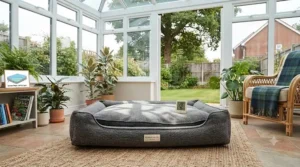
Solving Common Conservatory Dog Problems
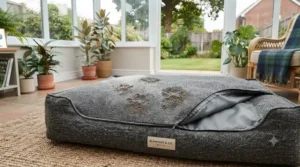
Muddy paw prints tracked straight from the garden onto pale conservatory flooring are probably the most universal complaint among owners of this kind of space, and the fix is usually as simple as positioning a washable-cover bed directly by the exterior door, so your dog has an immediate spot to settle rather than wandering the whole room first. Sun-faded bed fabric is another recurring issue — beds left permanently in a south-facing spot will visibly bleach within a season or two, so rotating the bed’s position every few weeks, or simply choosing a UV-resistant fabric from the outset, solves this before it becomes a problem. Chewed frame corners show up often with younger or anxious dogs, and elevated metal-framed beds generally hold up better here than wooden alternatives, since there’s simply less to gnaw at the base level. Overheating remains the big one, and the solution is almost always a combination approach — elevation plus shade plus a water bowl kept topped up nearby, rather than relying on any single fix. Thoughtful pet-friendly room design ties all of this together: treating the bed’s position, the flooring, and the room’s natural light pattern as one connected decision rather than three separate ones.
How to Choose a Dog Bed for Conservatory Living
- Assess your conservatory’s aspect first. A south-facing room needs active cooling and shade far more urgently than a north or east-facing space, so let compass direction guide your bed type before anything else.
- Prioritise elevation for hot rooms. Based on the spec comparison across this list, beds raising a dog even 15-20cm off the floor consistently outperform flat mats on airflow and heat reduction.
- Check fabric washability. Conservatories collect dust, pollen, and shed fur faster than most rooms, so a fully removable, machine-washable cover isn’t optional — it’s essential upkeep.
- Match support to your dog’s age and joints. Younger, healthy dogs generally do fine on mesh cots; older dogs or those with known joint issues benefit far more from memory foam options like the Trixie Vital Bed Noah.
- Think about winter, not just summer. A bed that only solves overheating leaves you scrambling for a second bed once temperatures drop, so favour genuinely all-season conservatory dog bed options where possible.
- Size the bed to your traffic pattern. Measure the actual usable floor space around furniture and doors before ordering — conservatories often have less clear floor area than they visually suggest.
- Factor in your dog’s climbing ability. Puppies, seniors, and smaller breeds may struggle with taller elevated cots, making low-profile cooling mats the more practical choice.
Common Mistakes When Buying a Dog Bed for Conservatory Use
The single most common misstep is buying based purely on how a bed looks in a listing photo, without considering the room’s actual sun exposure — a beautifully styled bed placed in a sun trap will sit unused by mid-July regardless of how attractive it is. A close second is assuming any “cooling” bed works identically; gel-based cooling mats and elevated mesh cots solve the heat problem through completely different mechanisms, and picking the wrong type for your specific room layout means underwhelming results. Buyers also frequently underestimate frame durability needs for larger or more energetic dogs, choosing a lightweight budget frame that then wobbles or bends within months. Another frequent oversight is skipping washable-cover options entirely, not realising how much more airborne dust and pollen circulates through a glazed room with doors regularly open. Finally, plenty of owners buy a single bed and expect it to perform equally well across all four seasons, when in reality most conservatories genuinely benefit from either a versatile all-season design or a light seasonal rotation between two beds.
Dog Bed for Glass-Walled Rooms vs Standard Indoor Beds
A standard indoor dog bed — the kind designed for a carpeted living room or bedroom — is built around insulation and softness, assuming a fairly stable ambient temperature year-round. A dog bed for glass-walled rooms has to solve an entirely different problem: managing temperature swings that can exceed 10°C between shaded and sun-exposed spots in the same room on the same afternoon. That’s why the products on this list lean so heavily toward elevation, breathable mesh, and washable covers, while a typical living-room bed prioritises plush padding and thermal retention instead. Standard beds also tend to use fabrics that aren’t UV-tested, meaning colours fade and materials can degrade noticeably faster under direct glazed sunlight than they would tucked into a corner of a normal room. The trade-off works both ways, though — many conservatory-specific beds sacrifice some of the deep-cushioned softness of a standard indoor bed in favour of that structural airflow, so a dog that’s genuinely sensitive to firm surfaces may need a hybrid option like the Trixie Vital Bed Noah, which brings orthopaedic cushioning into a conservatory-appropriate, washable package rather than forcing a straight choice between comfort and climate resilience.
Conservatory Flooring Types and What They Mean for Your Dog’s Bed
The flooring underneath your chosen bed matters more than most owners initially realise. Ceramic and porcelain tiles look sharp and clean easily, but they run notably cold underfoot through winter, which is precisely why an elevated bed — rather than a flat mat directly on tile — makes such a meaningful difference for comfort in colder months. Luxury vinyl tiles and water-resistant laminate are generally regarded as some of the most practical conservatory flooring options available, since they resist moisture and pair well with underfloor heating where fitted, giving a raised bed a genuinely temperature-stable base to sit on regardless of season. Standard, non-waterproof laminate is worth avoiding directly beneath a water bowl or a bed prone to damp paw prints, since moisture exposure can cause boards to bubble or warp over time. Engineered wood offers a warmer, more premium look but shares some of laminate’s sensitivity to humidity swings, so it suits conservatories with more stable climate control rather than ones left to fluctuate freely. Whatever flooring you have, a bed with a non-slip or elevated base helps protect the surface from scratches and moisture damage simultaneously, which is a genuinely underrated bonus most owners don’t think about until it’s already a problem.
Safety, Regulations and Conservatory Compliance for Dog Owners
Most conservatories qualify as permitted development and don’t require full planning permission, though building regulations still apply to glazing and any structural openings connecting the conservatory to the rest of the house — worth bearing in mind if you’re considering adding independent heating or insulation specifically to make the room more dog-friendly year-round. Beyond structural compliance, the welfare consideration matters just as much: animal welfare charities have repeatedly warned that conservatories, much like cars and caravans, can become dangerously hot enough to cause heatstroke within a short window on warm days, and advice on cooling an overheating dog safely generally centres on stopping activity, cooling gradually with water below body temperature, and seeking veterinary help promptly rather than waiting to see if symptoms pass. Practically, this means a dog bed for conservatory use should never be treated as a substitute for supervision on genuinely hot days — even the best cooling bed can’t fully offset a closed-up room with no airflow. Keeping a water bowl within easy reach of the bed, ensuring at least one door or vent can stay open, and never relying on the conservatory as an unsupervised space during a heatwave are the basics that keep a comfortable set-up from becoming a risky one.
Features That Actually Matter (And Those That Don’t)
Elevation genuinely matters — it’s not marketing fluff, and the temperature difference between floor level and a raised cot in direct sun can be significant. Washable covers matter too, given how much debris moves through a glazed room with regular door access to the garden. What tends to matter far less than the packaging suggests are elaborate colour-changing “smart cooling” claims on cheaper mats, which in aggregated reviewer experience often underperform compared with straightforward mesh elevation at a fraction of the price. Canopy attachments are a genuinely useful feature for south-facing rooms but largely pointless in shaded or north-facing conservatories, so it’s worth skipping that add-on cost if your room doesn’t need it. Orthopaedic memory foam is a real, measurable benefit for older dogs specifically, but it’s an unnecessary premium for a young, healthy dog who’d get equal comfort from a simpler mesh cot. The takeaway, broadly: prioritise features that solve your specific room’s actual conditions rather than the longest feature list on the product page.
Pet-Friendly Room Design: Blending Style and Practicality
A genuinely pet-friendly room design treats the dog bed as part of the room’s layout, not an afterthought squeezed in wherever there happened to be space. Positioning matters visually as well as functionally — a bed tucked into a defined corner, away from major foot traffic paths and door swings, tends to get used far more consistently than one plonked in the room’s centre. Colour coordination is a small but genuinely satisfying touch; the neutral tones common across beds like the Bedsure Elevated Dog Bed or Scruffs Cool Grey Dog Bed tend to blend into most conservatory colour schemes without looking like an obvious add-on. Storage matters too — a nearby basket for spare covers, toys, or a folded blanket keeps the space tidy without requiring a full utility cupboard. For households using the conservatory as a genuine living space rather than a purely functional extension, thoughtful consideration of glazing and ventilation during any renovation can meaningfully improve year-round comfort for both humans and dogs sharing the room, making the whole space more usable across all four seasons rather than just the mild ones either side of summer.
FAQ
❓ What's the best dog bed for a hot conservatory?
❓ Can dogs sleep in a conservatory overnight?
❓ How do I stop my dog's bed fading in a sunroom?
❓ Are elevated dog beds better than flat mats for conservatories?
❓ What flooring is safest for dogs in a conservatory?
Conclusion
Getting a dog bed for conservatory living right really comes down to reading your specific room honestly — its light pattern, its winter temperature drop, its flooring — rather than assuming any single popular bed will automatically work. The Amazon Basics Raised Dog Bed and Bunty Sided & Raised Dog Bed cover the budget end nicely for anyone still testing the waters, while the Bedsure Elevated Dog Bed, K&H Pet Products Coolin’ Cot Elevated Dog Bed, and iNap Raised Dog Bed with Folding Legs each bring their own mid-range strengths depending on your dog’s size and your room’s seasonal swing. The Scruffs Cool Grey Dog Bed solves for owners who want passive cooling without elevation, and the Trixie Vital Bed Noah remains the strongest pick where joint support genuinely outweighs active cooling as the priority. Whichever you land on, pairing the right bed with smart placement, seasonal awareness, and basic heat safety turns a conservatory from a room your dog tolerates into one they genuinely choose to nap in.
Recommended for You
- Chew-Proof Dog Bed: 7 Indestructible Picks For UK Homes (2026)
- Wipe-Clean Dog Bed: 7 Best Easy-Care Picks for UK Homes (2026)
- Non-Slip Dog Bed Guide: 7 UK Picks That Stop Sliding (2026)
Disclaimer: This article contains affiliate links. As an Amazon Associate, I earn from qualifying purchases. If you purchase products through these links, we may earn a small commission at no additional cost to you.
✨ Found this helpful? Share it with your friends! 💬🤗
